Article
A misleading acute respiratory failure: when infection is not where you expect it
Pequignot, B., Barraud, D., Stephan, C. et al.
Intensive Care Med (2026). https://doi.org/10.1007/s00134-026-08484-5
- Unusual pathogens matter: Corynebacterium spp., including Corynebacterium diphtheriae, can cause invasive infections beyond classical diphtheria, including bacteremia and prosthetic infections. Recent epidemiological and clinical studies report a resurgence of diphtheria in the European Union, with a notable increase in cutaneous forms. Toxin-producing strains may lead to severe systemic complications. In suspected toxigenic forms, early administration of diphtheria antitoxin is crucial.
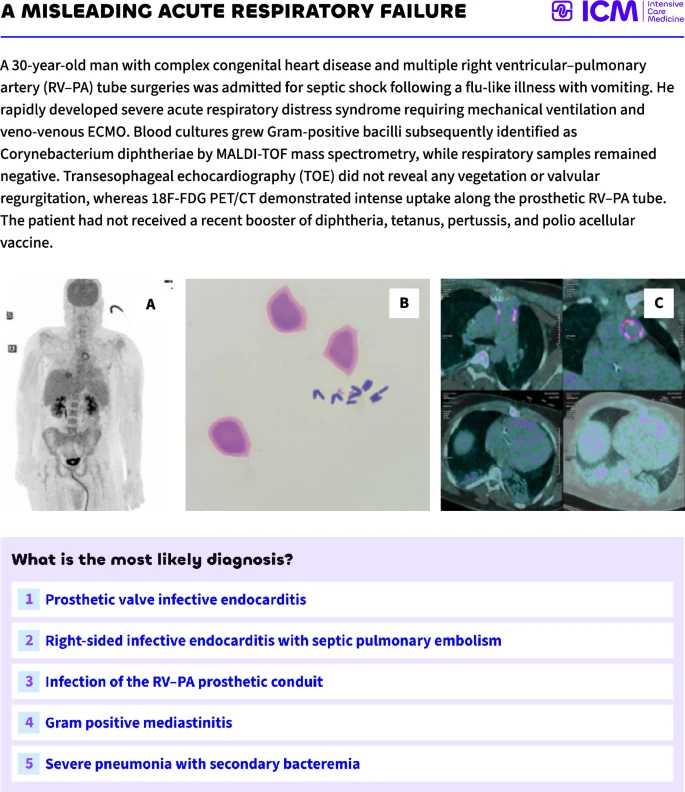
- Microbiological clues are essential: Gram-positive bacilli isolated from blood cultures should not automatically be dismissed as contaminants. Irregular, club-shaped organisms arranged in palisades or “Chinese letter” formations should prompt consideration of Corynebacterium spp. Definitive species identification requires dedicated microbiological methods, including MALDI-TOF mass spectrometry, while additional toxin testing may be required in suspected toxigenic strains (Fig. 1).
- Think beyond the valves: Infection may involve prosthetic conduits or vascular grafts, not only native or prosthetic valves
- Imaging pitfalls:
- TOE may be limited in assessing extracardiac prosthetic material
- 18F-FDG PET/CT can be a useful adjunct imaging modality
- ARDS can be misleading: Severe respiratory failure may reflect systemic sepsis rather than primary pulmonary infection alone.
- Management implications: Appropriate antimicrobial therapy (e.g., amoxicillin; linezolid in suspected toxin-producing strains), multidisciplinary evaluation, and careful assessment of potential prosthetic involvement
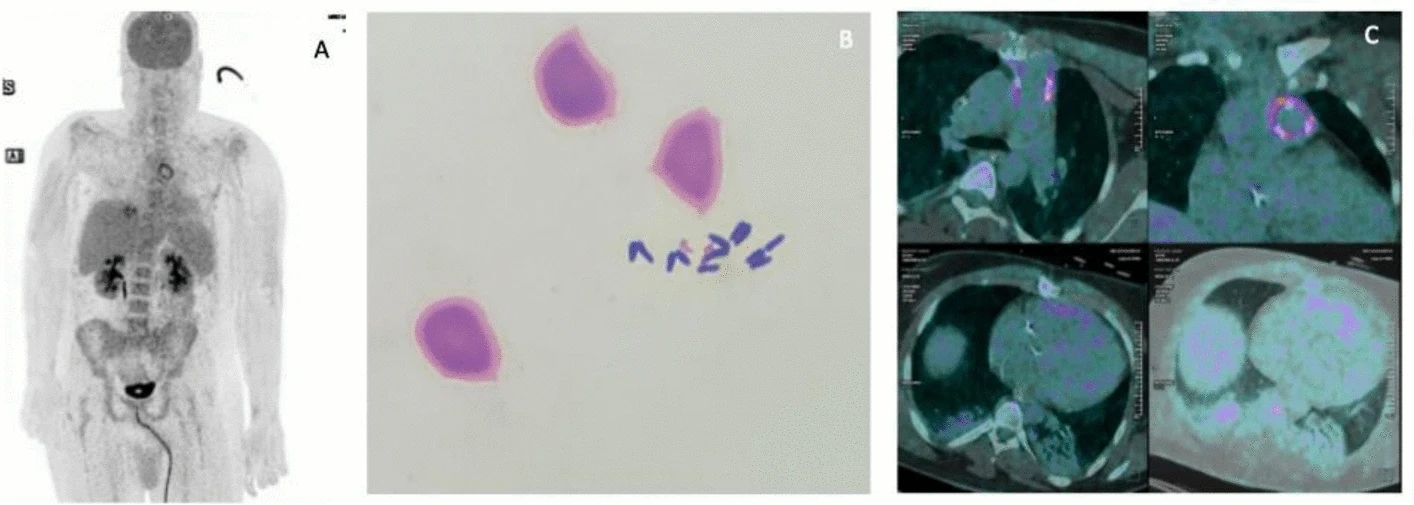
A 18F-FDG PET/CT Maximum intensity projection image demonstrating intense focal hypermetabolism along the RV–PA prosthetic, without evidence of other hypermetabolic. B Blood culture gram staining revealing Gram-positive bacilli with characteristic irregular, club-shaped morphology arranged in palisades (“Chinese letters” appearance) suggestive of Corynebacterium spp. C Fused PET/CT axial image shows increased 18F-FDG uptake surrounding the prosthetic material, with elevated standardized uptake values, consistent with prosthetic infection
