Research
Novel antihyperglycaemic drugs and prevention of chronic obstructive pulmonary disease exacerbations among patients with type 2 diabetes: population based cohort study
Richeek Pradhan, Sally Lu, Hui Yin, et al
BMJ 2022; 379 doi: https://doi.org/10.1136/bmj-2022-071380 (Published 01 November 2022)Cite this as: BMJ 2022;379:e071380
Abstract
Objective To determine whether the use of glucagon-like peptide 1 (GLP-1) receptor agonists, dipeptidyl peptidase 4 (DPP-4) inhibitors, and sodium-glucose co-transporter-2 (SGLT-2) inhibitors, separately, is associated with a decreased risk of exacerbations of chronic obstructive pulmonary disease among patients with chronic obstructive pulmonary disease and type 2 diabetes.
Design Population based cohort study using an active comparator, new user design.
Setting The United Kingdom Clinical Practice Research Datalink linked with the Hospital Episode Statistics Admitted Patient Care and Office for National Statistics databases.
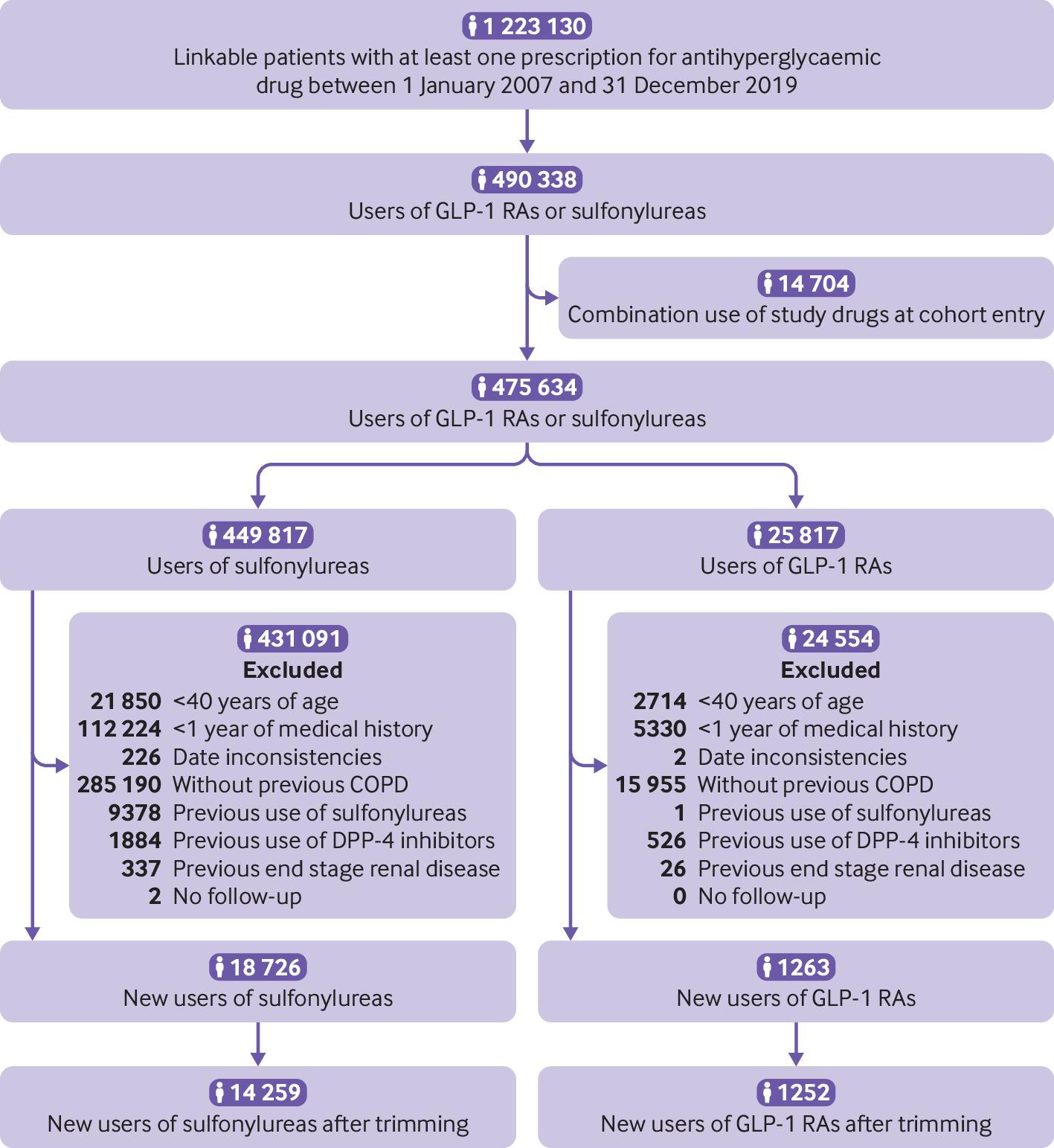
Participants Three active comparator, new user cohorts of patients starting the study drugs (GLP-1 receptor agonists, DPP-4 inhibitors, or SGLT-2 inhibitors) or sulfonylureas with a history of chronic obstructive pulmonary disease. The first cohort included 1252 patients starting GLP-1 receptor agonists and 14 259 starting sulfonylureas, the second cohort included 8731 patients starting DPP-4 inhibitors and 18 204 starting sulfonylureas, and the third cohort included 2956 patients starting SGLT-2 inhibitors and 10 841 starting sulfonylureas.
Main outcome measures Cox proportional hazards models with propensity score fine stratification weighting were fitted to estimate hazard ratios and 95% confidence intervals of severe exacerbation of chronic obstructive pulmonary disease (defined as hospital admission for chronic obstructive pulmonary disease), separately for GLP-1 receptor agonists, DPP-4 inhibitors, and SGLT-2 inhibitors. Whether these drugs were associated with a decreased risk of moderate exacerbation (defined as a co-prescription of an oral corticosteroid and an antibiotic along with an outpatient diagnosis of acute chronic obstructive pulmonary disease exacerbation on the same day) was also assessed.
Results Compared with sulfonylureas, GLP-1 receptor agonists were associated with a 30% decreased risk of severe exacerbation (3.5 v 5.0 events per 100 person years; hazard ratio 0.70, 95% confidence interval 0.49 to 0.99) and moderate exacerbation (0.63, 0.43 to 0.94). DPP-4 inhibitors were associated with a modestly decreased incidence of severe exacerbation (4.6 v. 5.1 events per 100 person years; hazard ratio 0.91, 0.82 to 1.02) and moderate exacerbation (0.93, 0.82 to 1.07), with confidence intervals including the null value. Finally, SGLT-2 inhibitors were associated with a 38% decreased risk of severe exacerbation (2.4 v 3.9 events per 100 person years; hazard ratio 0.62, 0.48 to 0.81) but not moderate exacerbation (1.02, 0.83 to 1.27).



Conclusions In this population based study, GLP-1 receptor agonists and SGLT-2 inhibitors were associated with a reduced risk of severe exacerbations compared with sulfonylureas in patients with chronic obstructive pulmonary disease and type 2 diabetes. DPP-4 inhibitors were not clearly associated with a decreased risk of chronic obstructive pulmonary disease exacerbations.
