Original Investigation November 5, 2019
Effect of Caspofungin vs Fluconazole Prophylaxis on Invasive Fungal Disease Among Children and Young Adults With Acute Myeloid Leukemia: A Randomized Clinical Trial
Brian T. Fisher, Theoklis Zaoutis, Christopher C. Dvorak, et al
JAMA. 2019;322(17):1673-1681. doi:10.1001/jama.2019.15702
Importance 背景
Children, adolescents, and young adults with acute myeloid leukemia are at high risk of life-threatening invasive fungal disease with both yeasts and molds.
患有急性髓系白血病的儿童和青少年发生致命性侵袭性真菌感染的危险很高。
Objective 目的
To compare the efficacy of caspofungin vs fluconazole prophylaxis against proven or probable invasive fungal disease and invasive aspergillosis during neutropenia following acute myeloid leukemia chemotherapy.
在急性髓系白血病化疗后粒细胞缺乏期间,比较卡泊芬静与氟康唑预防对于确诊或可疑的侵袭性真菌病及侵袭性曲霉菌病的预防作用。
Design, Setting, and Participants 设计、场景与研究人群
This multicenter, randomized, open-label, clinical trial enrolled patients aged 3 months to 30 years with newly diagnosed de novo, relapsed, or secondary acute myeloid leukemia being treated at 115 US and Canadian institutions (April 2011-November 2016; last follow-up June 30, 2018).
这项多中心、随机、开放标签临床试验,入选患者为美国和加拿大115所医院3个月至30岁的新确诊、复发或继发急性髓系白血病患者,入选时间为2011年4月至2016年11月,最后随访日期为2018年6月30日。
Interventions 干预措施
Participants were randomly assigned during the first chemotherapy cycle to prophylaxis with caspofungin (n = 257) or fluconazole (n = 260). Prophylaxis was administered during the neutropenic period following each chemotherapy cycle.
在第一次化疗周期期间,患者接受随机分组,分别接受卡泊芬静(n = 257)或氟康唑(n = 260)预防。在随后每个化疗周期的粒细胞缺乏期间都进行预防。
Main Outcomes and Measures 主要预后指标
The primary outcome was proven or probable invasive fungal disease as adjudicated by blinded central review. Secondary outcomes were invasive aspergillosis, empirical antifungal therapy, and overall survival.
主要预后终点为确诊或可疑的侵袭性真菌病(由设盲的中心审查判定)。次要预后指标为侵袭性曲霉菌病,经验性抗真菌治疗及总体生存率。
Results 结果
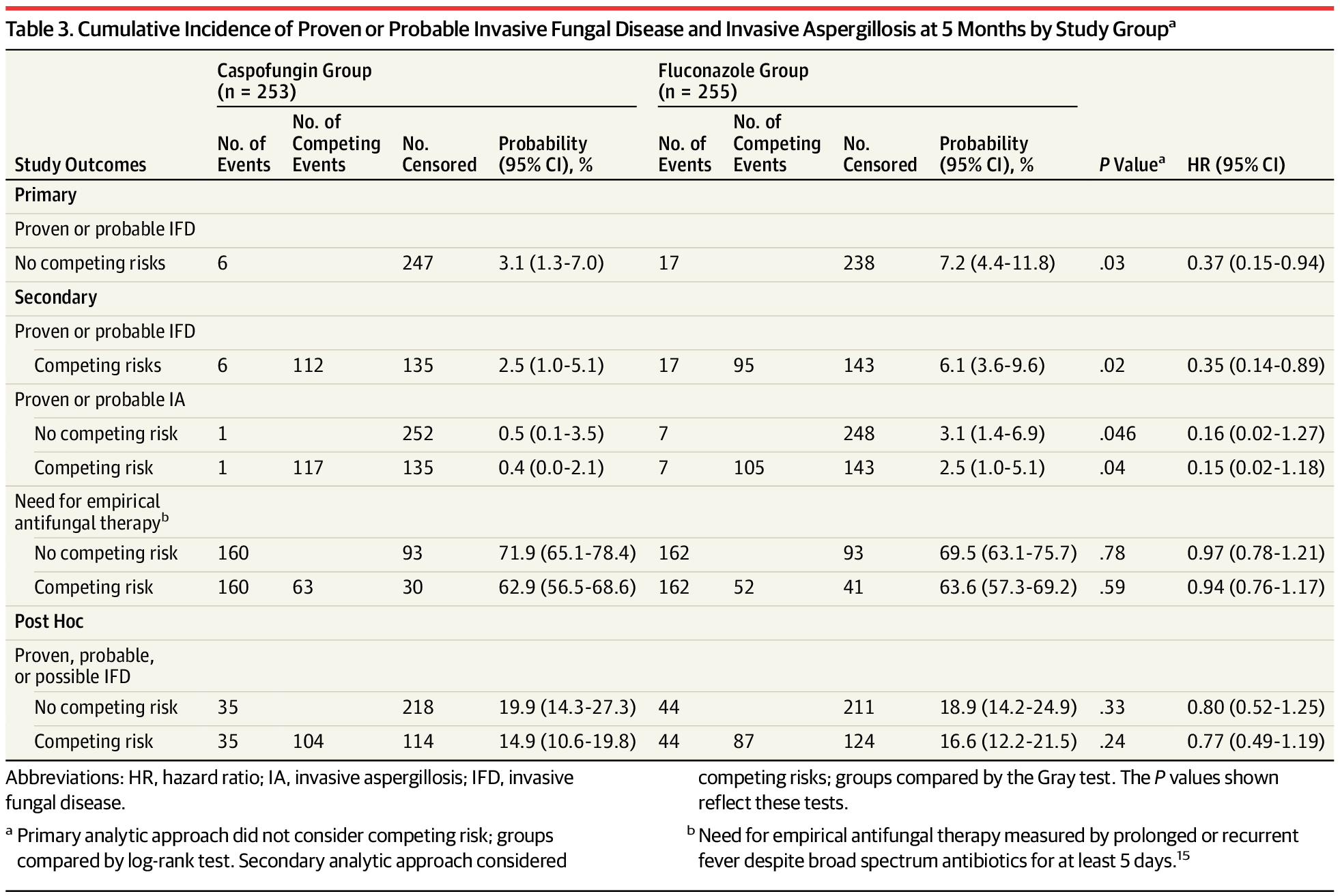
The second interim efficacy analysis and an unplanned futility analysis based on 394 patients appeared to have suggested futility, so the study was closed to accrual. Among the 517 participants who were randomized (median age, 9 years [range, 0-26 years]; 44% female), 508 (98%) completed the trial. The 23 proven or probable invasive fungal disease events (6 caspofungin vs 17 fluconazole) included 14 molds, 7 yeasts, and 2 fungi not further categorized. The 5-month cumulative incidence of proven or probable invasive fungal disease was 3.1% (95% CI, 1.3%-7.0%) in the caspofungin group vs 7.2% (95% CI, 4.4%-11.8%) in the fluconazole group (overall P = .03 by log-rank test) and for cumulative incidence of proven or probable invasive aspergillosis was 0.5% (95% CI, 0.1%-3.5%) with caspofungin vs 3.1% (95% CI, 1.4%-6.9%) with fluconazole (overall P = .046 by log-rank test). No statistically significant differences in empirical antifungal therapy (71.9% caspofungin vs 69.5% fluconazole, overall P = .78 by log-rank test) or 2-year overall survival (68.8% caspofungin vs 70.8% fluconazole, overall P = .66 by log-rank test) were observed. The most common toxicities were hypokalemia (22 caspofungin vs 13 fluconazole), respiratory failure (6 caspofungin vs 9 fluconazole), and elevated alanine transaminase (4 caspofungin vs 8 fluconazole).
第二次中期疗效分析以及基于394名患者的非计划无效分析提示治疗无效,因此研究终止入选患者。在接受随机分组的 517 名患者中 (中位年龄, 9 岁 [范围, 0-26 岁]; 44% 女性),508名 (98%) 完成了试验。共发生了23例确诊或可疑的侵袭性真菌病(卡泊芬静组6 vs 氟康唑组 17),包括14例霉菌,7例念珠菌及2例无法分类的真菌。确诊或可疑侵袭性真菌病的5个月累计发病率为,卡泊芬静组3.1% (95% CI, 1.3%-7.0%),氟康唑组7.2% (95% CI, 4.4%-11.8%) (log-rank检验 P = .03),确诊或可疑侵袭性曲霉菌病累计发病率卡泊芬静组 0.5% (95% CI, 0.1%-3.5%),氟康唑组 3.1% (95% CI, 1.4%-6.9%) (log-rank检验 P = .046 by log-rank test)。两组间经验性抗真菌治疗比例 (卡泊芬静71.9% vs 氟康唑69.5%, log-rank检验 P = .78) 或2年生存率 (卡泊芬静68.8% vs 氟康唑70.8%, log-rank检验 P = .66)均无统计学显著差异。最常见的毒性作用包括低钾血症 (卡泊芬静22 vs 氟康唑13),呼吸功能衰竭(卡泊芬静6 vs 氟康唑9)以及谷丙转氨酶升高(卡泊芬静4 vs 氟康唑8)。


Conclusions and Relevance 结论与意义
Among children, adolescents, and young adults with acute myeloid leukemia, prophylaxis with caspofungin compared with fluconazole resulted in significantly lower incidence of invasive fungal disease. The findings suggest that caspofungin may be considered for prophylaxis against invasive fungal disease, although study interpretation is limited by early termination due to an unplanned interim analysis that appeared to have suggested futility.
对于急性髓系白血病的患儿及青少年,与氟康唑相比,卡泊芬静预防显著降低侵袭性真菌病的发病率。由于非计划中期分析提示治疗无效,因而研究结果的解读受到早期终止的影响,但是研究结果提示,可以考虑使用卡泊芬静预防侵袭性真菌病。
Trial Registration 试验注册
ClinicalTrials.gov Identifier: NCT01307579
