Research
Accuracy of glomerular filtration rate estimation based on creatinine and cystatin C for monitoring moderate chronic kidney disease in adults: prospective, longitudinal cohort study
Katie Scandrett, Alice J Sitch, Jonathan Barratt, et al
BMJ 2026; 392 doi: https://doi.org/10.1136/bmj-2025-085005 (Published 19 March 2026)Cite this as: BMJ 2026;392:e085005
Abstract
Objectives To provide evidence on the longitudinal accuracy of glomerular filtration rate (GFR) estimating equations that include creatinine and cystatin C to monitor patients with moderate chronic kidney disease.
Design Prospective, longitudinal, cohort study.
Setting Primary, secondary, and tertiary care across six centres in England, 1 April 2014 to 31 December 2017.
Participants 1229 adults (≥18 years) with moderate chronic kidney disease (creatinine estimated GFR of 30-59 mL/min/1.73 m2 for at least three successive months before recruitment).
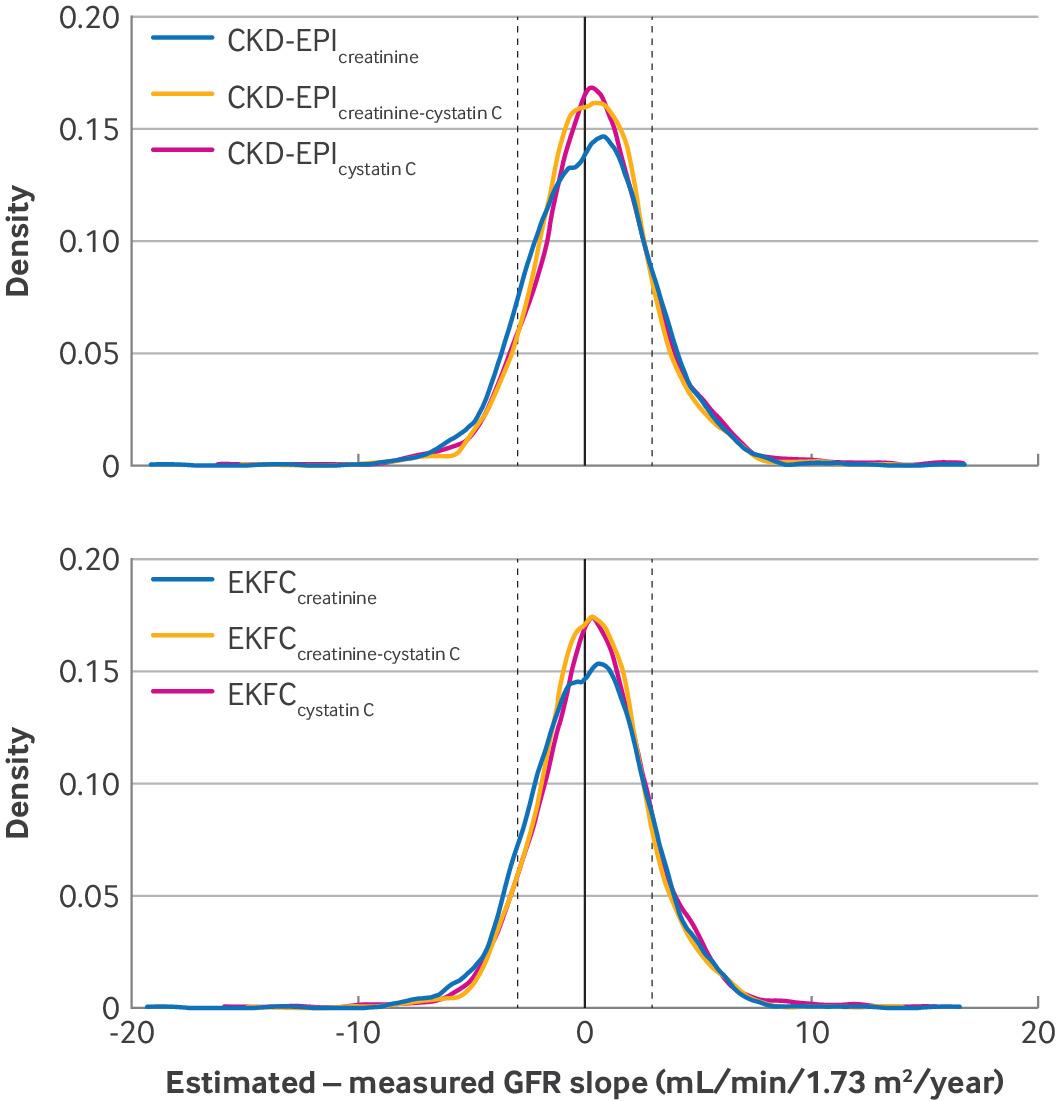
Main outcome measures Ability of estimating equations to monitor GFR over three years, with slope deviations from reference measured GFR (iohexol clearance) within ±3 mL/min/1.73 m2/year indicating agreement. Ability of GFR estimating equations to detect disease progression (ie, a reduction in measured GFR of ≥25% with a reduction in disease category).
Results After three years, 875 participants had measured and estimated GFR data recorded at the start and end of the study and comprised the study cohort. Median measured GFR decreased from 48.1 mL/min/1.73 m2 at baseline to 43.6 mL/min/1.73 m2 at three years. GFR was estimated with the Chronic Kidney Disease Epidemiology Collaboration (CKD-EPI) and European Kidney Function Consortium (EKFC) estimating equations. Median change in measured GFR exceeded median change in estimated GFR for all equations. All equations achieved agreement with change in measured GFR in >72.5% of participants. Dual biomarker equations showed better agreement with change in measured GFR (CKD-EPIcreatinine-cystatin 78.6% of individuals, 95% confidence interval 75.8% to 81.3%; CKD-EPI(2021)creatinine-cystatin 78.1%, 75.2% to 80.8%; and EKFCcreatinine-cystatin 80.2%, 77.4% to 82.8%) than CKD-EPIcreatinine (73.1%, 70.1% to 76.1%) (all P<0.001). Progression of kidney disease was seen in 139 (15.9%) individuals. All GFR equations had poor sensitivity (<54.1%) but good specificity (>90.4%) for identifying progression of chronic kidney disease.
Conclusions Underestimation of the reduction in GFR by estimated GFR requires further investigation. Equations that included both creatinine and cystatin C more accurately monitored change in measured GFR than equations based on one biomarker. Increased use of combined biomarker equations in clinical practice could improve disease monitoring and potentially clinical care.
Study registration ISRCTN registry ISRCTN42955626.
