Article
Monitoring SARS-CoV-2 in air and on surfaces and estimating infection risk in buildings and buses on a university campus
Xin Zhang, Jianfeng Wu, Lauren M. Smith, et al
J Expo Sci Environ Epidemiol (2022). 27 April 2022
https://doi.org/10.1038/s41370-022-00442-9
Abstract
Background
Evidence is needed on the presence of SARS-CoV-2 in various types of environmental samples and on the estimated transmission risks in non-healthcare settings on campus.
Objectives
The objective of this research was to collect data on SARS-CoV-2 viral load and to examine potential infection risks of people exposed to the virus in publicly accessible non-healthcare environments on a university campus.
Methods
Air and surface samples were collected using wetted wall cyclone bioaerosol samplers and swab kits, respectively, in a longitudinal environmental surveillance program from August 2020 until April 2021 on the University of Michigan Ann Arbor campus. Quantitative rRT-PCR with primers and probes targeting gene N1 were used for SARS-CoV-2 RNA quantification. The RNA concentrations were used to estimate the probability of infection by quantitative microbial risk assessment modeling and Monte-Carlo simulation.
Results
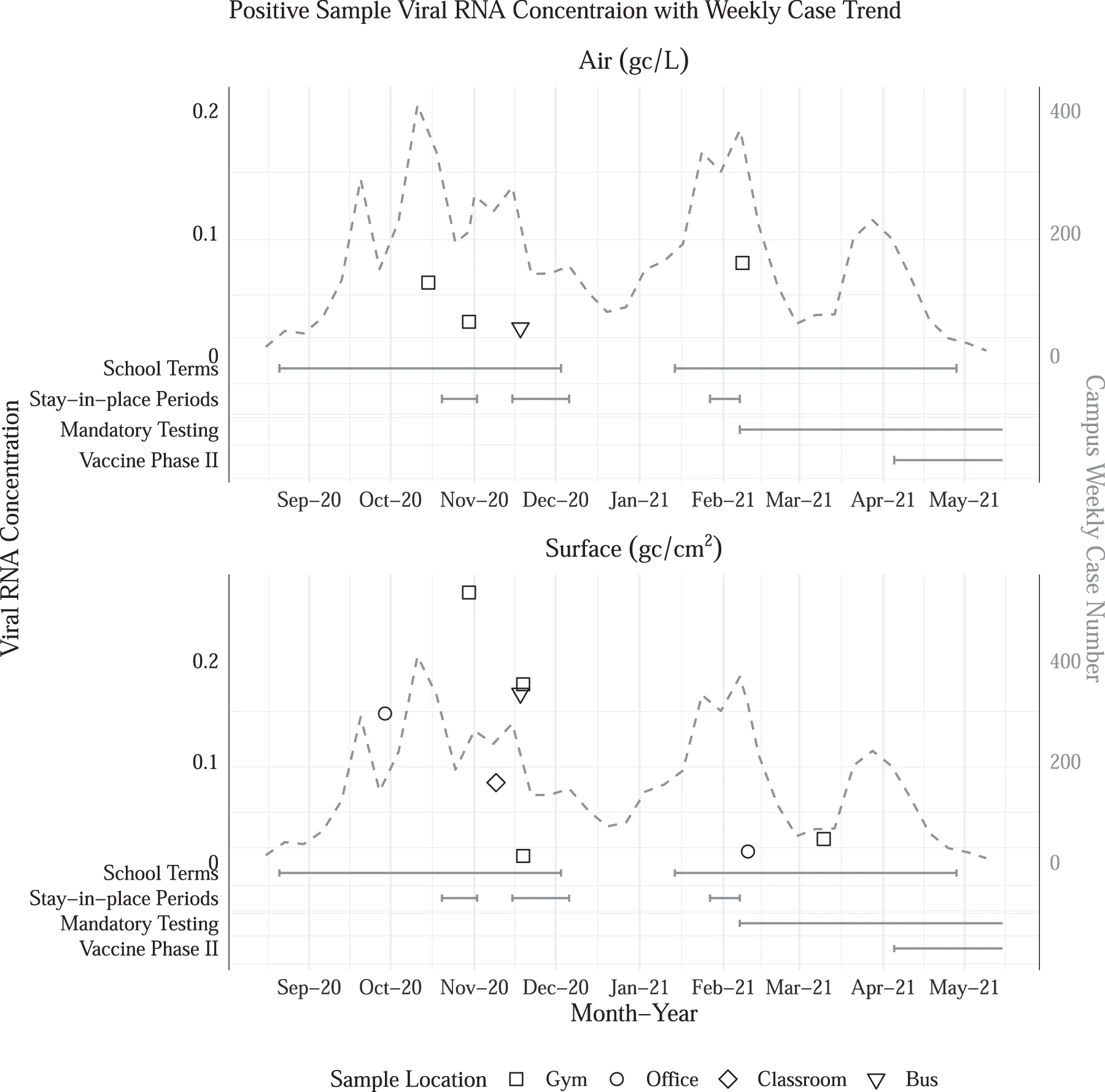
In total, 256 air samples and 517 surface samples were collected during the study period, among which positive rates were 1.6% and 1.4%, respectively. Point-biserial correlation showed that the total case number on campus was significantly higher in weeks with positive environmental samples than in non-positive weeks (p = 0.001). The estimated probability of infection was about 1 per 100 exposures to SARS-CoV-2-laden aerosols through inhalation and as high as 1 per 100,000 exposures from contacting contaminated surfaces in simulated scenarios.

Significance
Viral shedding was demonstrated by the detection of viral RNA in multiple air and surface samples on a university campus. The low overall positivity rate indicated that the risk of exposure to SARS-CoV-2 at monitored locations was low. Risk modeling results suggest that inhalation is the predominant route of exposure compared to surface contact, which emphasizes the importance of protecting individuals from airborne transmission of SARS-CoV-2 and potentially other respiratory infectious diseases.
Impact
Given the reoccurring epidemics caused by highly infectious respiratory viruses in recent years, our manuscript reinforces the importance of monitoring environmental transmission by the simultaneous sampling and integration of multiple environmental surveillance matrices for modeling and risk assessment.
以下内容来自上海市细胞生物学学会公众号
【学术前沿】Nature子刊:新冠病毒通过物传人的概率,仅为空气传播的千分之一
两年多过去了,新冠病毒仍在全世界范围内广泛传播。了解疾病的暴露风险,有助于提前制定缓解策略,控制住这种高传染性的呼吸道病毒。
美国疾病预防控制中心(CDC)将SARS-CoV-2的传播方式归类为:病毒吸入、病毒在粘膜上沉积,以及粘膜与被病毒污染的手接触。基于此,佩戴口罩、保持社交距离、对密切接触者追踪/隔离,是控制新冠疫情的关键预防措施。
那么,新冠病毒能否通过物体表面以及空气,在环境中进行传播呢?
早期研究表明,无症状、症状前和有症状的携带者可能会播散病毒颗粒,这些病毒颗粒可以在气溶胶中保持存活和传染性数小时,并在物体表面存活长达 3 天,具体取决于温度、相对湿度和表面材料等环境因素。
最近的研究发现,病毒可以在塑料、不锈钢、玻璃、陶瓷、木材、棉花和纸等表面上存活4到7天。在适当的温度下(实验条件下<30 °C),它能存活更长时间。
因此,评估新冠病毒通过气溶胶或物体表面传播的可能性大小,对于控制新冠疫情和制定相关措施至关重要。
近日,密歇根大学公共卫生学院奚传武教授团队等在 Journal of Exposure Science & Environmental Epidemiology (Nature子刊)发表了题为:Monitoring SARS-CoV-2 in air and on surfaces and estimating infection risk in buildings and buses on a university campus 的研究论文。
该研究对几所大学校园及周围场所的空气和物体表面进行了采样和新冠病毒检测,结合校园的新冠感染情况,来评估环境接触相关的新冠传播概率。
具体来说,研究团队收集了256个空气样本,其中1.6%的样本新冠病毒检测呈阳性。收集了517多个物体表面样本,1.5%为阳性。
这些样本来自这办公室、教室、表演空间、自助餐厅、公共汽车和健身房。其中,最危险的环境是健身房,健身房中采集的75%的空气样本和50%的物体表面样本都发现了新冠病毒阳性迹象。大多数受污染的健身房物体表面都涉及饮水机按钮,但健身器材上采集的样本没有发现阳性。总体而言,在办公空间、电脑键盘、电灯开关、桌面、微波炉、冰箱把手或课桌周围发现的阳性要少得多。
研究者评估了病毒RNA样本呈阳性位置的平均感染风险和95%的感染风险(表 2)。吸入感染的风险,因暴露持续时间而异(图 2)。
表2:阳性样品详情和检测到的病毒RNA浓度
例如,在健身房以 98% 采样病毒浓度水平(0.06 gc/L)进行40分钟的中高强度间歇训练后,不戴口罩的人的感染概率为每1000次暴露中出现15 ± 6次吸入传染性气溶胶。
在公共汽车上,当公共汽车上的空气被浓度为 0.023 gc/L 的 SARS-CoV-2 污染时,如果乘坐5-15分钟的公共汽车,100,000名不戴口罩的乘客中有15人可能因吸入而感染。使用在表面检测到的病毒浓度,通过污染物传播的估计感染风险为1/100000。
这种风险水平意味着,在单次触摸受污染的表面,然后单次手指与粘膜接触后,SARS-CoV-2 感染的可能性为100,000分之一。
换句话说,气溶胶每100次接触感染为1.5次左右。而接触新冠病毒阳性物体表面后感染的概率则非常之低,每10万次接触仅有1次感染机会。
这项研究结果表明,与接触门把手、饮水机、键盘、桌子、开关等等物体表面相比,通过空气吸入导致新冠病毒感染的风险要高得多,大约高出1000倍。提醒我们,应该更加关注通过空气吸入新冠病毒的风险,而不是接触物体表面的感染风险,尤其是那些定期清洁的环境中的物体表面。
不过,研究人员也指出这项研究有几个局限性。
首先,位置可达性、人员可用性和样本代表性是本研究中的重要考虑因素,因此限制了抽样的规模和频率。
其次,鉴于为减轻 COVID-19 传播而采取的封锁措施和政策,没有在大量人群中采集样本,并且在只有少数人在场时采集了一些样本,因此需要解释负面结果尤其是在室内活动逐渐恢复到大流行前水平的情况下,请谨慎行事。
第三,该研究是在大学校园内进行的,因此将这些发现外推到普通人群或其他非医疗保健环境时应谨慎。
尽管存在这些限制,我们相信我们的结果是对各种非医疗保健环境中的环境污染和传染性数据的有价值的补充。
对于这项研究,西蒙斯大学的 Elizabeth Scott 教授表示,越来越多的研究表明,新冠主要通过空气传播,WHO 也证实了这一点。但需要指出的是,虽然物体表面传播的风险很低,但实际生活中,人们会反复接触相同的物体表面,因此传播的风险会相应升高。
同时,她还强调,这种私人空间风险并未得到该研究的评估。 此外,重要的是要注意“其他呼吸道病毒和其他细菌感染主要通过接触表面传播,”Simmons大学家庭和社区卫生与健康中心前联合主任Scott补充说。
在Scott看来,“我们需要继续对手和物体表面以及呼吸道和空气卫生进行有效和全面的卫生实践,以防止在 COVID-19 之前存在的所有其他社区传播感染”。
另外,梅斯医学还认为,Omicron在物体表面存活的时间,有研究认为比原始株更长,意味着,针对Omicron的物传人的可能性也会增大,需要进行独立的研究。
