Original Investigation | Caring for the Critically Ill Patient
Effect of an ICU Diary on Posttraumatic Stress Disorder Symptoms Among Patients Receiving Mechanical Ventilation: A Randomized Clinical Trial
Maité Garrouste-Orgeas, Cécile Flahault, Isabelle Vinatier, et al
JAMA. 2019;322(3):229-239. doi:10.1001/jama.2019.9058
Abstract
Importance 背景
Keeping a diary for patients while they are in the intensive care unit (ICU) might reduce their posttraumatic stress disorder (PTSD) symptoms.
在患者住ICU期间保留日记可能减轻其创伤后应激综合征(PTSD)的症状。
Objectives 目的
To assess the effect of an ICU diary on the psychological consequences of an ICU hospitalization.
评价ICU日记对ICU住院患者精神结局的影响。
Design, Setting, and Participants 设计,场景和研究对象
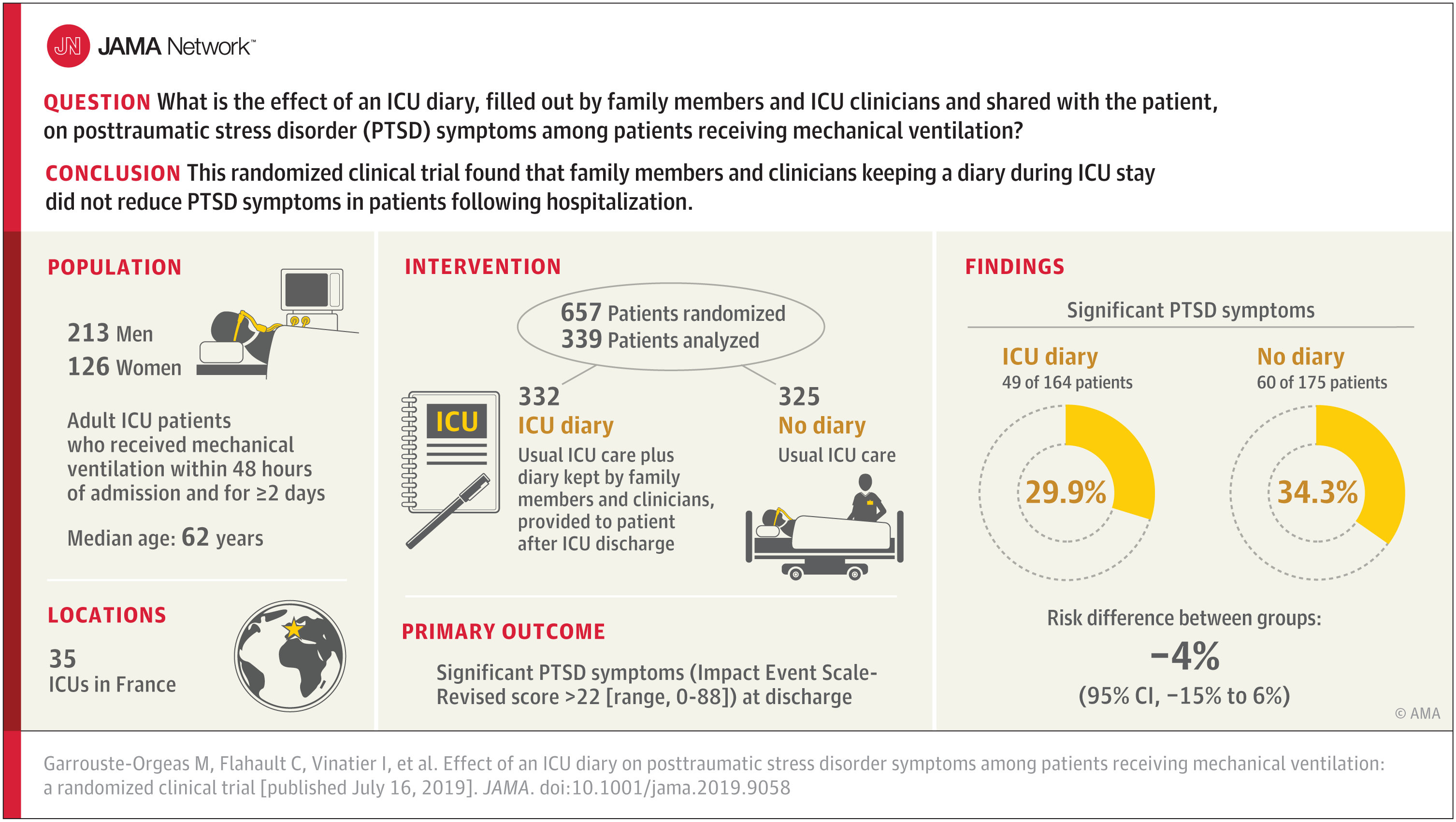
Assessor-blinded, multicenter, randomized clinical trial in 35 French ICUs from October 2015 to January 2017, with follow-up until July 2017. Among 2631 approached patients, 709 adult patients (with 1 family member each) who received mechanical ventilation within 48 hours after ICU admission for at least 2 days were eligible, 657 were randomized, and 339 were assessed 3 months after ICU discharge.
2015年10月至2017年1月,法国35个ICU参加的评估者设盲的多中心随机临床试验,最后随访日期为2017年7月。在2631名筛查患者中,709名成年患者在入住ICU后48小时内接受机械通气至少2天。这些患者(及1名家属)符合入选标准,最终657名接受随机分组,339名患者在转出ICU后3个月接受评估。
Interventions 干预措施
Patients in the intervention group (n = 355) had an ICU diary filled in by clinicians and family members. Patients in the control group (n = 354) had usual ICU care without an ICU diary.
干预组患者 (n = 355) 由医务人员和家属负责填写 ICU 日记。对照组患者 (n = 354) 接受常规ICU治疗,且没有ICU日记。
Main Outcomes and Measures 主要预后指标
The primary outcome was significant PTSD symptoms, defined as an Impact Event Scale-Revised (IES-R) score greater than 22 (range, 0-88; a higher score indicates more severe symptoms), measured in patients 3 months after ICU discharge. Secondary outcomes, also measured at 3 months and compared between groups, included significant PTSD symptoms in family members; significant anxiety and depression symptoms in patients and family members, based on a Hospital Anxiety and Depression Scale score greater than 8 for each subscale (range, 0-42; higher scores indicate more severe symptoms; minimal clinically important difference, 2.5); and patient memories of the ICU stay, reported with the ICU memory tool.
主要预后指标为转出ICU后3个月根据修订的影响事件量表(IES-R) > 22分定义的明显PTSD症状(范围,0-88;分值越高提示症状越严重)。次要预后指标也在3个月后评估,包括家属明显的PTSD症状;患者及家属明显的焦虑和抑郁症状(基于医院焦虑和抑郁量表各项评分超过8分[范围,0-42;分值越高提示症状越严重;具有临床意义的最小差异,2.5);以及患者对于ICU住院期间的记忆(通过ICU记忆工具报告)。
Results 结果
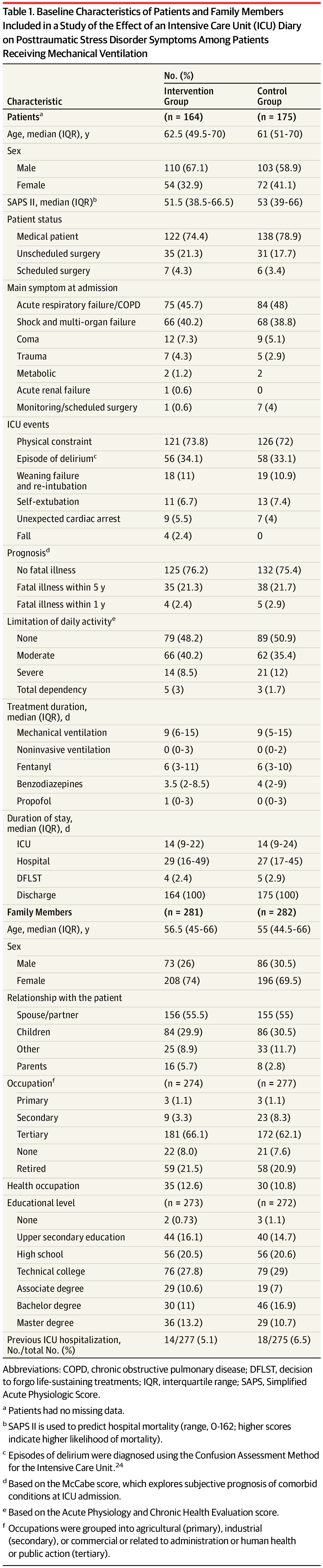
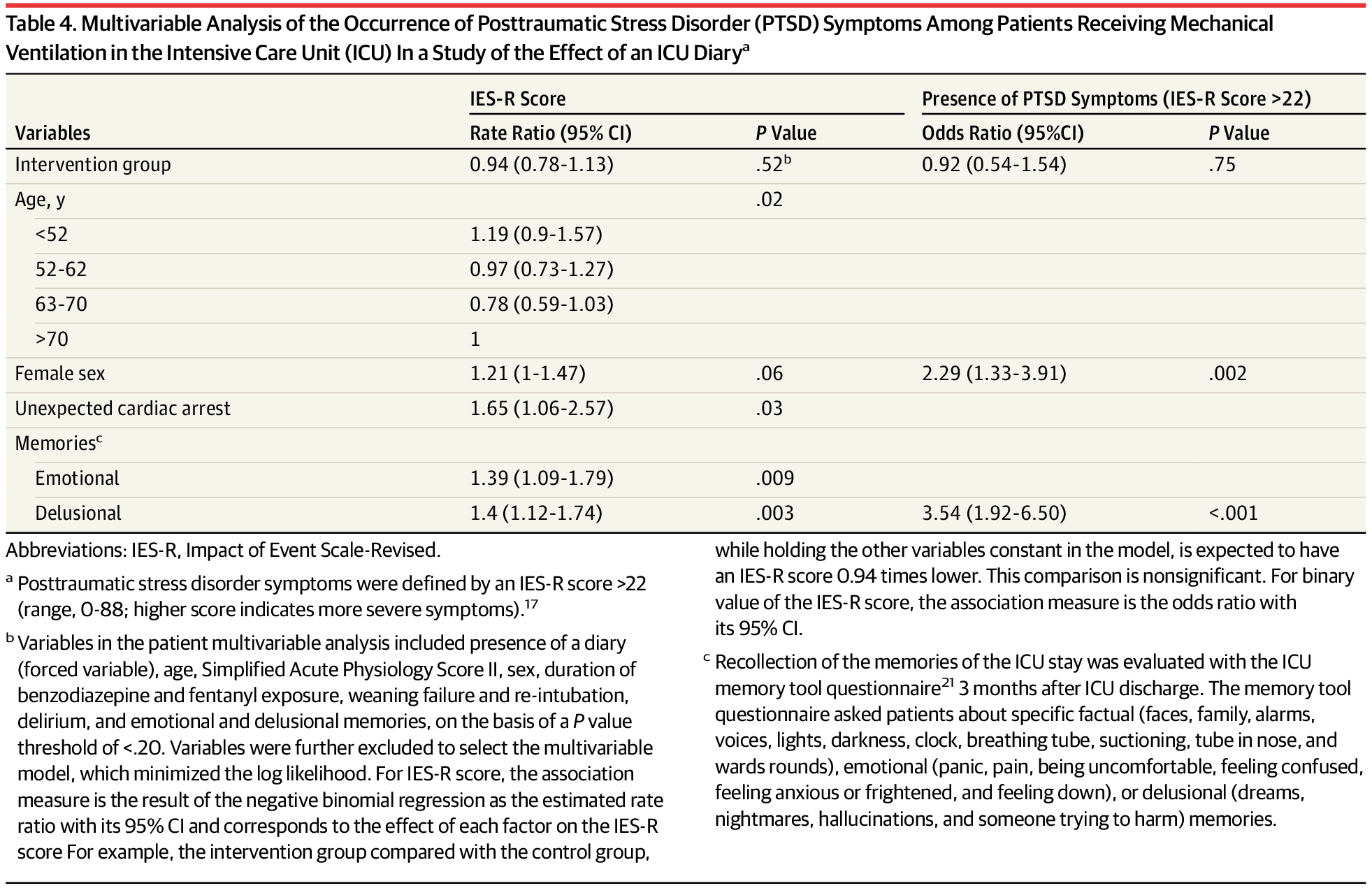
Among 657 patients who were randomized (median [interquartile range] age, 62 [51-70] years; 126 women [37.2%]), 339 (51.6%) completed the trial. At 3 months, significant PTSD symptoms were reported by 49 of 164 patients (29.9%) in the intervention group vs 60 of 175 (34.3%) in the control group (risk difference, −4% [95% CI, −15% to 6%]; P = .39). The median (interquartile range) IES-R score was 12 (5-25) in the intervention group vs 13 (6-27) in the control group (difference, −1.47 [95% CI, −1.93 to 4.87]; P = .38). There were no significant differences in any of the 6 prespecified comparative secondary outcomes.
总共657名患者接受随机分组(中位[四分位区间]年龄62 [51-70] 岁;126 名女性 [37.2%]),339 名 (51.6%) 完成试验。在3个月时,干预组164名患者中49名 (29.9%) 以及对照组175名患者中60名 (34.3%) 报告有明显的PTSD症状(风险差异,−4% [95% CI, −15% to 6%]; P = .39)。干预组 IES-R 评分中位数(四分位区间)为 12 (5-25) 分,对照组为 13 (6-27) 分(差异,−1.47 [95% CI, −1.93 to 4.87]; P = .38)。两组间预先确定的6项次要指标均无显著差异。



Conclusions and Relevance 结论与意义
Among patients who received mechanical ventilation in the ICU, the use of an ICU diary filled in by clinicians and family members did not significantly reduce the number of patients who reported significant PTSD symptoms at 3 months. These findings do not support the use of ICU diaries for preventing PTSD symptoms.
对于接受机械通气的ICU患者,由医务人员和家属填写ICU日记不能显著减少3个月时报告明显PTSD症状的患者数目。这些发现不支持使用ICU日记预防PTSD症状。
Trial Registration 试验注册
ClinicalTrials.gov Identifier: NCT02519725
评论[仅代表个人观点]
- 与研究的阴性结果相比,我们可能更为陌生的是ICU日记中都记录些什么?
- 为此,研究者特意制订了ICU日记撰写指南,鼓励参与病人诊治的医生和护士都加入这个行列
- 应当说,这一举措会使得病人和家属感到医务人员的情意
- 或许,比减少PTSD更现实的指标是满意度
举例说明
ICU日记的开始
Name of the nurse, date
This morning, you had a cardiac arrest at work. After the cardiac massage performed by your colleagues and the emergency transport team, your heart started to beat again. However, you did not get conscious immediately; therefore, you were transferred in the intensive care unit, and we put cold patches on all your body to decrease your body temperature up to 33°C for 24 hours, in order to protect your brain for possible sequelae.
ICU住院期间的日记
Name of the physiotherapist, date
You are still unconscious. Nevertheless, we set up a machine today that makes you cycling while you are lying in your bed. Everything went well, and you did not seem to have any pain.
Name of the nurse, date
I am Aurore, your nurse for tonight. As usual, we used fresh water for toileting you, really fresh! That is how you like it. Since your arrival, we are getting used to know what you appreciate. Hang in, so we will be able to sing the Connemara lake together!
