Research Special Paper
Patterns of war related trauma in Gaza during armed conflict: survey study of international healthcare workers
Omar El-Taji, Ameer Ali, Osaid Alser, et al
BMJ 2025; 390 doi: https://doi.org/10.1136/bmj-2025-087524 (Published 25 September 2025)Cite this as: BMJ 2025;390:e087524
Abstract
Objective To systematically document the patterns of war related injuries in Gaza, Palestine.
Design Survey study of international healthcare workers, August 2024 to February 2025.
Setting Gaza, Palestine.
Participants 78 international healthcare workers deployed to Gaza.
Main outcome measures The main outcome was the type of injuries observed by international healthcare workers during the conflict in Gaza. A Delphi informed survey was distributed through non-governmental organisation rosters and secure WhatsApp and email groups. Respondents completed the survey using contemporaneous logbooks and shift records.
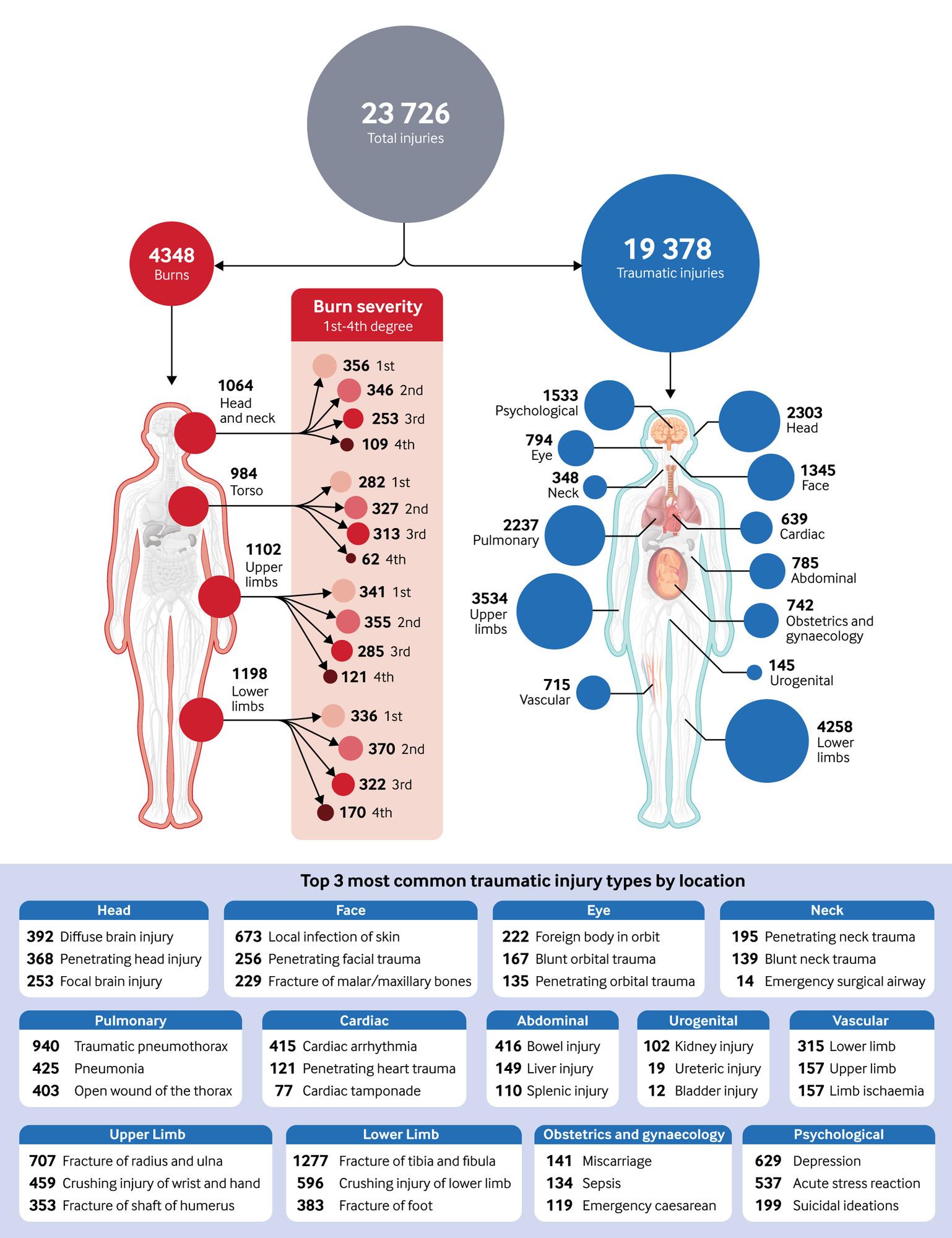
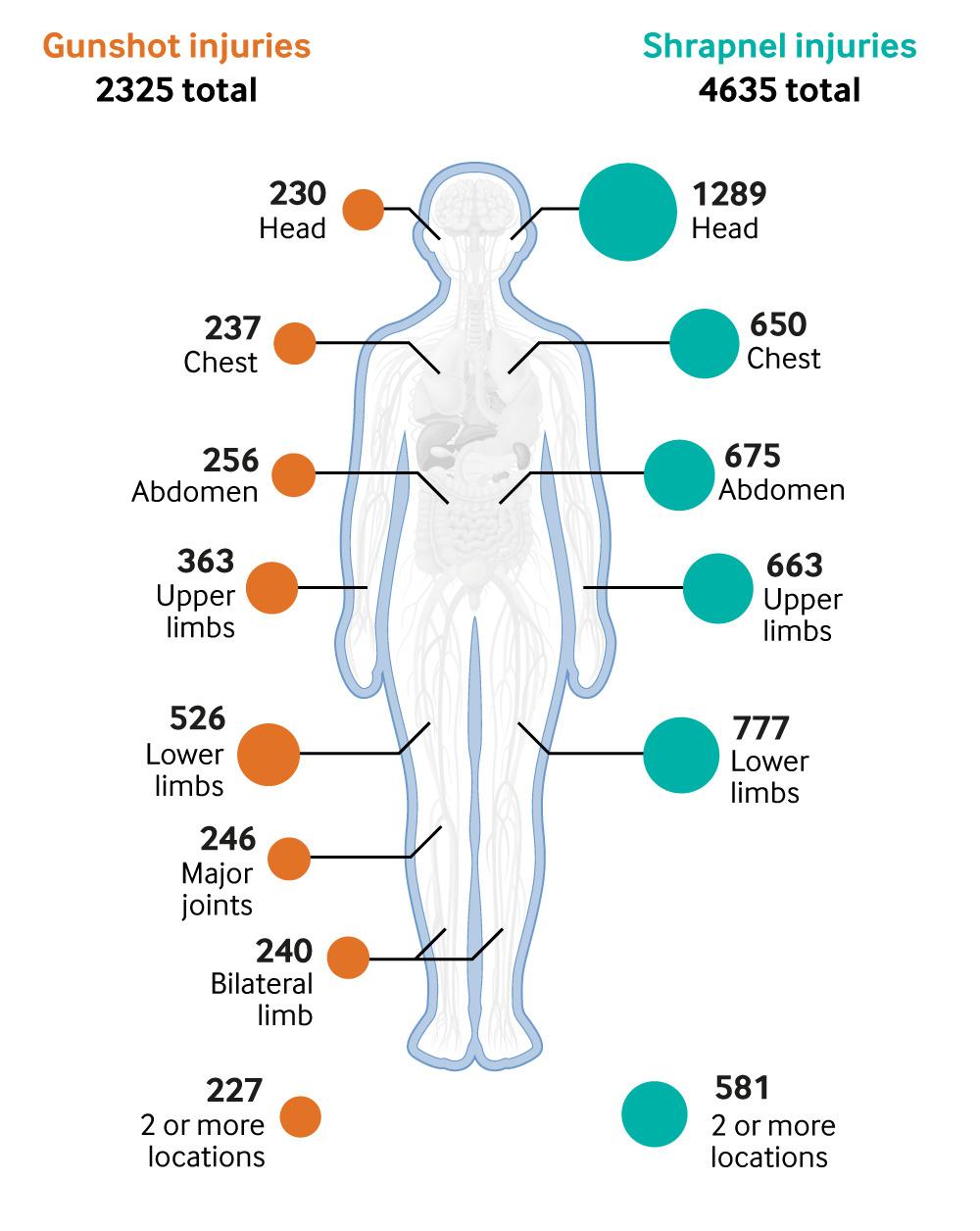
Results The survey collected data on 12 anatomical regions, mechanisms of trauma, and general medical conditions. 78 healthcare workers reported 23 726 trauma related injuries and 6960 injuries related to weapons. The most common traumatic injuries were burns (n=4348, 18.3%), lower limb injuries (n=4258, 17.9%), and upper limb injuries (n=3534, 14.9%). Explosive injuries accounted for most of the weapon related trauma (n=4635, 66.6%), predominantly affecting the head (n=1289, 27.8%), whereas firearm injuries disproportionately affected the lower limbs (n=526, 22.6%). Healthcare workers reported 4188 people with chronic disease across 11 domains requiring long term treatment.
Conclusion Healthcare workers deployed to Gaza reported an injury phenotype defined by extensive polytrauma (≥2 anatomical regions), complex blast injuries from high yield explosives, firearm related injuries to upper and lower limbs, and severe disruption to primary care and the treatment of chronic diseases. The results provide actionable insights to tailor humanitarian response and highlight the urgent need for structured, resilient clinical surveillance systems.
Editor’s note This paper is based on research from an active war zone, where conventional research methods may be impossible to apply.
