JAMA Clinical Guidelines Synopsis
Antiviral Therapies for Adults With Mild to Moderate COVID-19 Infection
Peggy B. Leung, Andrew M. Davis, Kristen M. Marks
JAMA Published Online: June 30, 2026
doi: 10.1001/jama.2026.6918
Guideline title 2025 Clinical Practice Guideline Update by the Infectious Diseases Society of America (IDSA) on the Treatment and Management of COVID-19: Antiviral Treatment for Mild to Moderate COVID-19 in Adults
Release date October 2025
Developer and funding source IDSA
Target population Patients with mild to moderate COVID-19 infection
Major recommendations
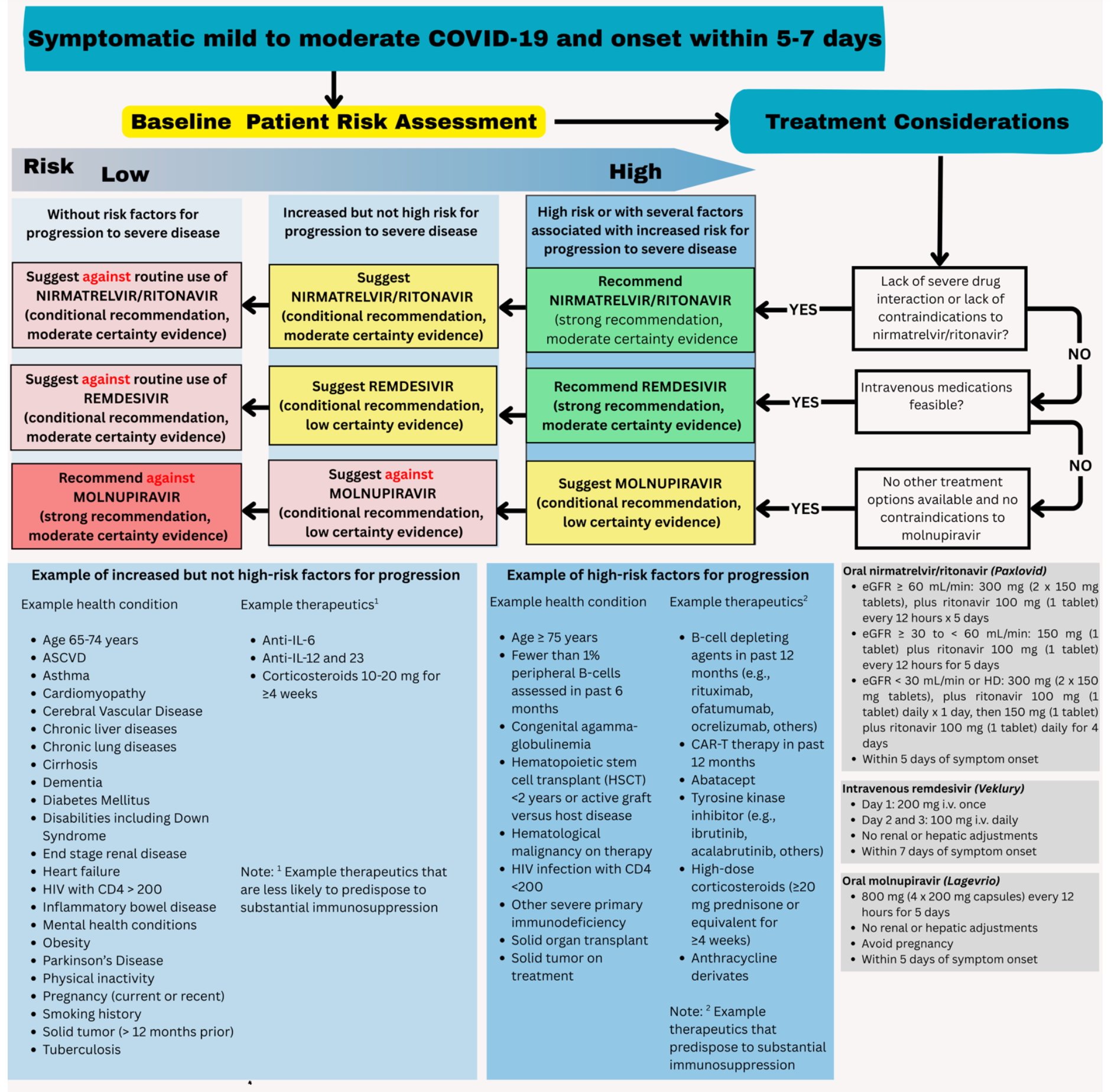
- For adults with mild to moderate COVID-19 (symptoms of respiratory infection with oxygen saturation >94% while breathing room air and no need for supplemental oxygen) at high risk of severe disease or with several risk factors for progression to severe disease, nirmatrelvir-ritonavir or intravenous remdesivir are recommended over no treatment (strong recommendation [SR]; moderate certainty of evidence [COE]). For patients taking medications that have severe drug interactions with nirmatrelvir-ritonavir or who do not have access to remdesivir, molnupiravir is suggested (conditional recommendation [CR]; low COE).
- For adults with mild to moderate COVID-19 at increased but not high risk for progression to severe disease, use of nirmatrelvir-ritonavir (CR; moderate COE) or intravenous remdesivir (CR; low COE) is suggested, but the guideline suggests against use of molnupiravir (CR; low COE).
- For adults without risk factors for progression to severe disease, not using nirmatrelvir-ritonavir or remdesivir is suggested (CR; moderate COE), and the guideline strongly recommends against use of molnupiravir (SR; moderate COE).
Summary of the Clinical Problem
With increasing population immunity through vaccination and prior infection, the risk of severe COVID-19, hospitalization, and death has substantially decreased in all age groups in the US since 2021.1 However, certain populations, especially those aged 65 years or older, remain at increased risk for progression to severe disease. This updated guideline provides a risk-stratified approach to antiviral therapies for patients with mild to moderate COVID-19 (defined as symptoms of respiratory infection with oxygen saturation >94% while breathing room air). Antiviral therapies are most effective when initiated within 5 to 7 days of COVID-19 symptom onset.
Characteristics of the Guideline Source
The guideline was developed by the IDSA and endorsed by the Society of Critical Care Medicine (eTable in the Supplement). As this is a living guideline, the IDSA performs monthly systematic literature reviews and reconvenes when new evidence emerges. This update identified 18 unique randomized clinical trials (RCTs) with a search date of September 2024 to support the recommendations. Recommendations were developed using GRADE methodology.
Evidence Base
For treatment of mild to moderate COVID-19 infection, the guideline included 3 SRs with moderate COE and 6 CRs (3 of moderate COE, 3 of low COE). SRs apply to most patients with few exceptions, while CRs apply to the majority but with many exceptions; shared decision-making is essential. The guideline panel used a risk-based framework, based partially on Centers for Disease Control and Prevention guidance about risk factors for developing severe COVID-19 derived from cohort data during the Omicron era (beginning late 2021), which may not reflect current population immunity or emerging variants.1,2 This guideline defined 3 risk categories: (1) high risk (expected hospitalization rate ≥6%), such as patients with older age (≥75 years), HIV infection with CD4 lymphocyte count less than 200/µL, solid organ transplant and hematologic malignancy treated with immunosuppressive therapy, or use of B cell–depleting agents (eg, rituximab) within the past 12 months; (2) increased but not high risk (expected hospitalization rate >0.5% to <6%), such as patients aged 65 to 74 years or with chronic cardiopulmonary disease, HIV with CD4 lymphocyte count of at least 200/µL, diabetes, obesity, pregnancy (current or <6 weeks post partum); and (3) without risk factors (expected hospitalization rate ≤0.5%). The guideline panel set a threshold for a minimum clinically meaningful reduction in hospitalizations at 10 to 20 per 1000 patients.
The guideline meta-analysis combined 2 RCTs (3373 participants) and compared nirmatrelvir-ritonavir with placebo in both high- and low-risk patients, reporting a hospitalization rate of 0.8% in the treatment group vs 4.5% in the placebo group (risk ratio [RR], 0.17; 95% CI, 0.10-0.31; moderate COE).1,3,4 Risk reduction in hospitalization with use of nirmatrelvir-ritonavir was greater among high-risk than low-risk patients, with 50 (95% CI, 41-54) fewer hospitalizations per 1000 in high-risk treated patients3 vs 4 (95% CI, 3-5) fewer hospitalizations per 1000 for those with no risk factors.1 In an RCT of 1956 participants at high risk of progression, 63.4% treated with nirmatrelvir-ritonavir had symptom resolution by day 28 (median, 16 days) vs 57.4% treated with placebo (median, 19 days; hazard ratio [HR], 1.20; 95% CI, 1.07-1.35).5 However, another RCT (1288 participants at all levels of risk of progression) reported no significant difference in sustained resolution of symptoms in those randomized to nirmatrelvir-ritonavir (72.9%; median, 12 days) vs placebo (74.1%; median, 13 days; P = .60 for time difference).4Nirmatrelvir-ritonavir did not increase rates of serious adverse events in a meta-analysis of 3 RCTs (3776 participants) vs placebo (1.8% vs 4.8%; RR, 0.52; 95% CI, 0.20-1.35).1
Prior to prescribing nirmatrelvir-ritonavir, clinicians should perform a careful medication review because ritonavir, a cytochrome P450 (CYP) 3A4 inhibitor that increases nirmatrelvir levels, can cause serious drug interactions. Coadministration of nirmatrelvir-ritonavir is contraindicated with certain medications due to risk of serious or fatal toxicity (eg, amiodarone, statins [especially simvastatin and lovastatin], or phosphodiesterase 5 inhibitors such as sildenafil, tamsulosin, triazolam, or midazolam) or medications with strong CYP3A inducers (eg, rifampin, carbamazepine, St John’s wort). In addition, nirmatrelvir-ritonavir can increase levels of immunosuppressive medications (tacrolimus, cyclosporine, sirolimus), which have a narrow therapeutic index. Therefore, use of nirmatrelvir-ritonavir with these medications may be inadvisable; however, most interactions can be managed with temporary discontinuation, dose adjustment, or substitution. Dose adjustment of nirmatrelvir-ritonavir is also required for patients with an estimated glomerular filtration rate less than 60 mL/min/1.73 m2. Another concern after treatment with nirmatrelvir-ritonavir is symptomatic viral rebound, defined as a return of COVID-19 symptoms, which occurs in 0.8% to 6.6% of patients in the first week after discontinuing nirmatrelvir-ritonavir.1 However, symptomatic viral rebound generally presents as a milder version of the initial infection and rarely leads to hospitalization.1 The guideline notes that evidence on retreatment for symptomatic rebound is lacking and offers no formal recommendation.
Regarding remdesivir, evidence from an RCT of 562 nonhospitalized patients with COVID-19 symptoms for 7 days or less and at least 1 risk factor for disease progression (age ≥60 years or coexisting medical conditions such as obesity, hypertension, cardiovascular disease, chronic lung disease, immunocompromise, or current cancer) reported that a 3-day course of intravenous remdesivir reduced the composite outcome of COVID-19–related hospitalization or death due to any cause vs placebo (0.7% vs 5.3%; HR, 0.13; 95% CI, 0.03-0.59; P = .008), with no deaths in either group by day 28.6 Remdesivir did not increase serious adverse events in a meta-analysis of 4 RCTs (1300 participants) vs placebo (14.2% vs 12.6%; RR, 0.78; 95% CI, 0.61-1.00).1 Unlike nirmatrelvir-ritonavir, remdesivir has few serious drug interactions and requires no dose adjustment for kidney or hepatic dysfunction. However, dosing of remdesivir, which requires intravenous administration over 3 consecutive days, presents logistical challenges in outpatient settings.
A meta-analysis of 6 RCTs evaluating molnupiravir (28 361 nonhospitalized patients with COVID-19 across all risk levels for progression) reported similar hospitalization rates for those treated with molnupiravir (1.2%) and placebo (1.3%) (RR, 0.86; 95% CI, 0.70-1.05).1 Molnupiravir should be avoided during pregnancy because it is mutagenic and associated with fetal harms such as skeletal malformation, reduced fetal weight, and abnormalities in bone and cartilage ossification. Molnupiravir should also not be taken during breastfeeding or by children younger than 18 years due to bone and cartilage effects. Sexually active females should use effective contraception during treatment and for 3 months after treatment with molnupiravir.
Discussion
The SR for high-risk patients with mild to moderate COVID-19 to use nirmatrelvir-ritonavir or remdesivir is supported by RCT evidence that these medications reduce hospitalizations. For patients at increased but not high risk, CRs emphasize shared decision-making, weighing modest benefits against potential adverse effects of treatment. Patients without risk factors for severe COVID-19 infection are unlikely to benefit from antiviral treatment.
Nirmatrelvir-ritonavir is recommended as first-line therapy due to its oral administration and high efficacy; remdesivir is an alternative if drug interactions prevent nirmatrelvir-ritonavir use. Molnupiravir should be prescribed only for high-risk adult patients who cannot receive other COVID-19 treatments and are not pregnant or breastfeeding.
Areas for Future Research
Development of newer antiviral medications that overcome current limitations—including drug-drug interactions, intravenous administration requirements, and reproductive safety concerns—would expand treatment options. Forthcoming data from ongoing trials such as a phase 3 RCT of oral ibuzatrelvir in severely immunocompromised patients may inform antiviral use in mild to moderate COVID-19. Additionally, research to develop validated predictive scoring tools derived from updated observational data could improve risk stratification and support more consistent risk assessment and guideline adoption. Studies evaluating real-world use of antiviral medications suggest current underprescribing in high-risk populations7 and highlight the need for implementation strategies for patients with COVID-19.