Vasopressors or Fluids in Early Septic Shock
The ARISE FLUIDS Investigators, the ANZICS Clinical Trials Group, and the ACEM Clinical Trials Network
N Engl J Med Published June 11, 2026
DOI: 10.1056/NEJMoa2516225
Abstract
BACKGROUND
The optimal approach to early resuscitation in septic shock is unknown. Equipoise exists between the use of larger volumes of intravenous fluids to restore perfusion and the use of early vasopressor therapy along with smaller volumes of fluids to minimize potential harm from excess fluid.
METHODS
We randomly assigned adult patients who presented to the emergency department with septic shock to receive either fluids at restricted volumes and early vasopressor therapy (vasopressor group) or higher volumes of fluids and later vasopressor therapy (fluids group) for at least 6 hours and up to 24 hours. The primary outcome was days alive and out of the hospital from randomization to day 90.
RESULTS
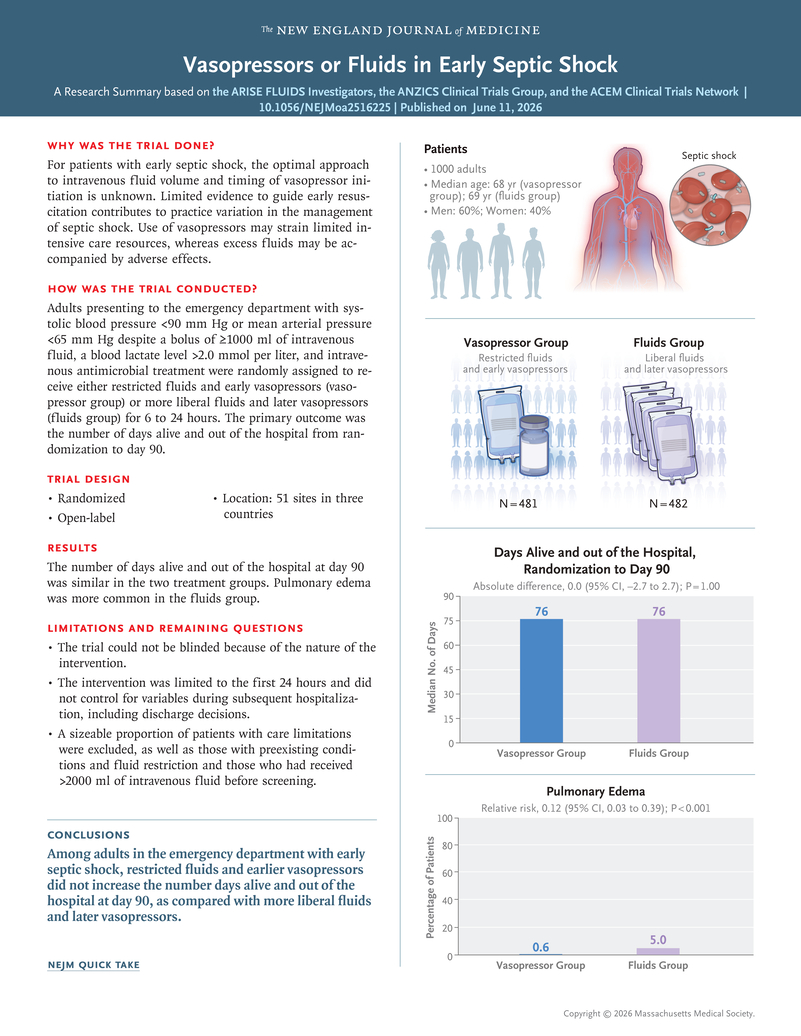
A total of 1000 patients underwent randomization, with 499 assigned to the vasopressor group and 501 to the fluids group. Informed consent was not obtained for 37 patients, which left 963 patients in the intention-to-treat population (481 in the vasopressor group and 482 in the fluids group). Three patients in the fluids group were lost to follow-up for the primary outcome. In the first 24 hours after randomization, patients in the vasopressor group received less intravenous fluid than those in the fluids group (median difference, −1108 ml; 95% confidence interval [CI], −1395 to −850). The percentage of patients who received vasopressors was higher by 18.9 percentage points (95% CI, 13.3 to 24.5) in the vasopressor group. The median number of days alive and out of the hospital at day 90 was 76 (interquartile range, 55 to 83) in the vasopressor group and 76 (interquartile range, 55 to 82) in the fluids group (difference, 0.0 days; 95% CI, −2.7 to 2.7; P=1.00). Adverse events occurred in similar percentages of patients in the two groups, except for pulmonary edema (0.6% in the vasopressor group vs. 5.0% in the fluids group; P<0.001).


CONCLUSIONS
Among adult patients who presented to the emergency department with septic shock, an approach that involved restricted fluid volume and early vasopressors did not result in a greater number of days alive and out of the hospital at day 90 than an approach involving greater fluid volume and later administration of vasopressors. (Funded by the Australian National Health and Medical Council Medical Research Future Fund and the New Zealand Health Research Council; ARISE FLUIDS ClinicalTrials.gov number, NCT04569942.)
