Article
What is your diagnosis? Severe barotrauma supported with VV-ECMO
Presa Orue, A., Lasa-Berasain, P., Ruiz Lucea, J. et al.
Intensive Care Med (2026). https://doi.org/10.1007/s00134-026-08472-9
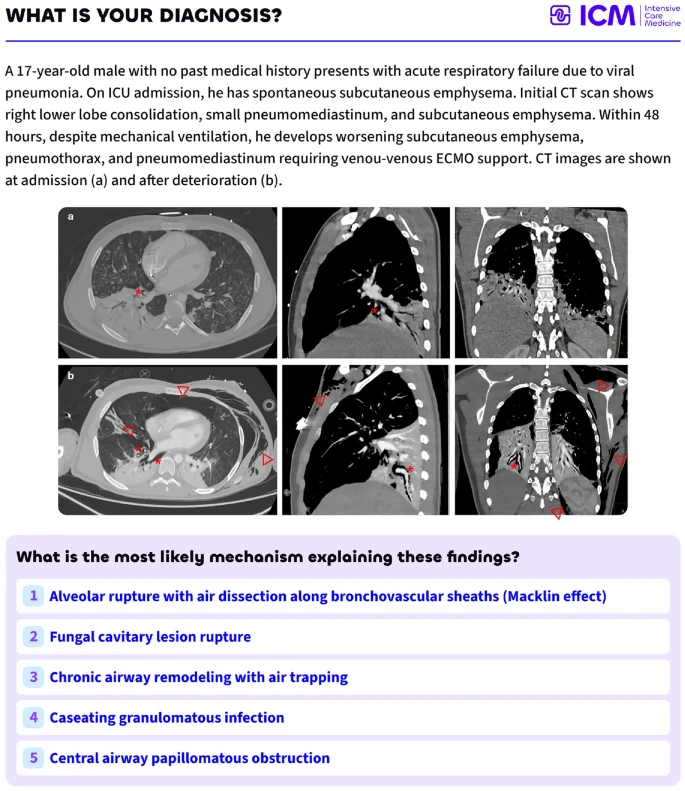
Macklin effect and progression to Hamman syndrome:
The Macklin effect describes a well-established pathophysiological and radiological mechanism in which air resulting from alveolar rupture dissects along the peribronchovascular sheaths and migrates toward the mediastinum. This process provides a mechanistic explanation for the development of spontaneous pneumomediastinum, also referred to as Hamman syndrome.
The sequence is typically initiated by an increase in intra-alveolar pressure, which may occur in various settings such as vigorous coughing, acute respiratory infections, trauma or positive-pressure ventilation [1, 2]. This pressure gradient can lead to alveolar rupture, allowing air to escape into the pulmonary interstitium. The air then tracks centripetally along the bronchovascular bundles until it reaches the mediastinum, where it accumulates.
On CT scan, the Makclin effect is characterized by linear collections of air outlining the bronchovascular structures. These findings may be subtle on initial imaging but often become more conspicuous over time. Recognizing this pattern is clinically important, as it frequently precedes the development or progression of pneumomediastinum and other manifestations of air leak.
In critically ill patients receiving mechanical ventilation, the identification of a Macklin effect should raise concern for increased susceptibility to barotrauma, with potential implications for ventilatory strategy and monitoring. Early recognition on imaging can help anticipate disease progression and guide clinical management [1,2,3] (Fig. 1).