Reducing Bacterial Contamination of Blood Bags with a Double Knot
Kathleen Selleng, Halima Ismail, Christian Kohler, et al
N Engl J Med 2026;394:1865-1866
DOI: 10.1056/NEJMc2600589
TO THE EDITOR:
Bacterial contamination of blood for transfusions poses a serious risk to patients, particularly in resource-limited settings.1 Blood centers in high-income nations use heat-sealed tubing to close blood bags after donation; however, these tools are unaffordable in most low-income countries, are dependent on reliable electricity, and are vulnerable to failure under challenging environmental conditions. Currently, single-knot closure is routinely used in all blood-donation services in Nigeria and most other countries in sub-Saharan Africa according to recommendations from military handbooks.2
We conducted a controlled study to investigate the effectiveness of a simple, low-cost intervention to reduce the risk of bacterial contamination of blood bags: the use of a double knot applied immediately proximal to the blood bag. The study sponsors (the German Federal Ministry for Economic Cooperation and Development and the Else Kröner-Fresenius Foundation) had no role in the design of the study; in the collection, analysis, or interpretation of the data; in the writing of the manuscript; or in the decision to submit the manuscript for publication.
We filled 180 pediatric blood bags with 48 to 52 ml of lysogeny broth (Lennox, Carl Roth) and closed the bag with either one knot (90 bags) or two knots (90 bags). Bacterial cultures (Staphylococcus aureus ATCC12600, Pseudomonas aeruginosa ATCC27853, or Escherichia coliDSM30833), grown to an optical density at 600 nm of 0.5, were introduced into tubing, which was connected by sterile docking to the blood bags. Care was taken to remove any air bubbles, with the result that 0.6×10⁸ to 1.0×10⁸ bacteria were in direct contact with the outer knot of each bag (Figure 1). The prepared blood bags were hung top down (such that the bacteria were in constant contact with the outer knot) and stored at 20 to 22°C for 35 days. On day 35, the culture medium was transferred to 50-ml tubes, bacteria were concentrated by centrifugation at 4400×g for 10 minutes, and the pellet was resuspended in 100 μl of lysogeny broth, which was spread onto blood agar plates containing Columbia agar and 5% sheep blood (Becton Dickinson). The plates were then incubated for 24 hours at 37°C.
FIGURE 1
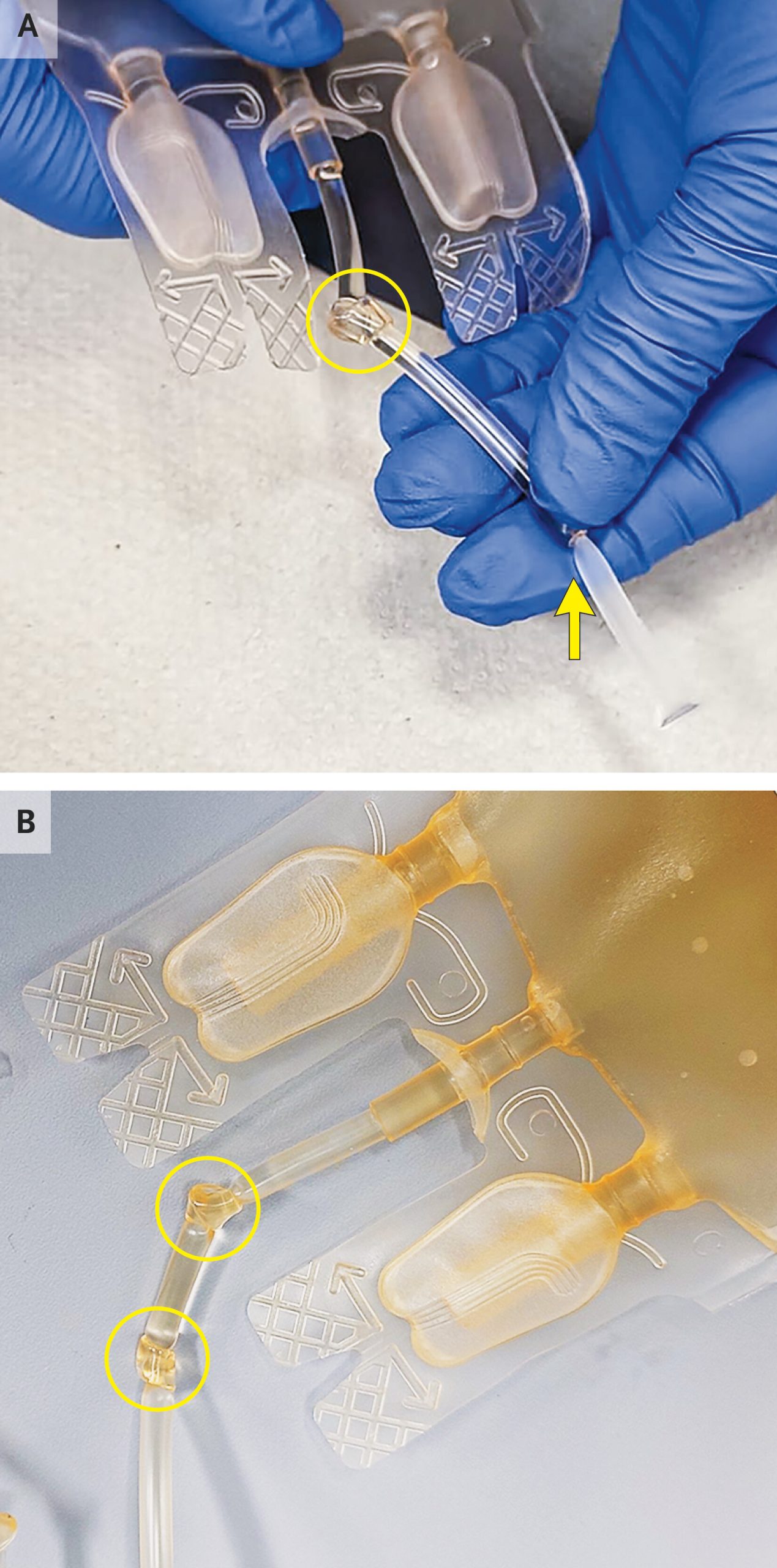
Closure of Blood-Bag Tubes with Knots.
Microbiologic testing showed substantial bacterial contamination in 8 of 90 blood bags that were sealed with a single knot (9%; two-sided exact Clopper–Pearson 95% confidence interval [CI], 4 to 17). In contrast, none of the 90 bags that were sealed with a double knot were contaminated (0%; two-sided exact Clopper–Pearson 95% CI, 0 to 4). Although the confidence intervals are wide, we used a high-stress test, with incubation of highly concentrated bacteria directly in front of the knot for 35 days at room temperature. Therefore, bacterial contamination of the tubing of blood bags sealed with double knots and stored at 4°C would be highly unlikely to lead to contamination of the bags.
These findings suggest that the use of a double knot is a simple, low-cost, and effective method for reducing the risk of bacterial contamination of blood bags. This intervention could substantially improve patient safety, particularly in resource-limited settings. Although metal clamps represent an alternative solution, they also strain the limited budgets of blood centers, with a cost of approximately $0.06 per piece; at 100 blood donations per day, this cost exceeds one employee’s daily wage in Nigeria.
For facilities that use a single knot to close the bag, the double knot, as part of a multifaceted approach to blood safety3 that includes proper disinfection of the skin in the area of the vein puncture, could decrease the rate of contamination by providing an additional layer of protection. Double-knot closure is simple to implement and requires minimal resources. In this study, double-knot closure was associated with a substantially lower risk of contamination than single-knot closure.
