Research
Cause specific mortality risks associated with tropical cyclones in multiple countries and territories: two stage, time series study
Wenzhong Huang, Rongbin Xu, Zhengyu Yang, et al
BMJ 2025; 391 doi: https://doi.org/10.1136/bmj-2025-084906 (Published 05 November 2025)Cite this as: BMJ 2025;391:e084906
Abstract
Objective To characterise and quantify the mortality risks for a range of causes after tropical cyclones in nine countries and territories.
Design Two stage, time series study.
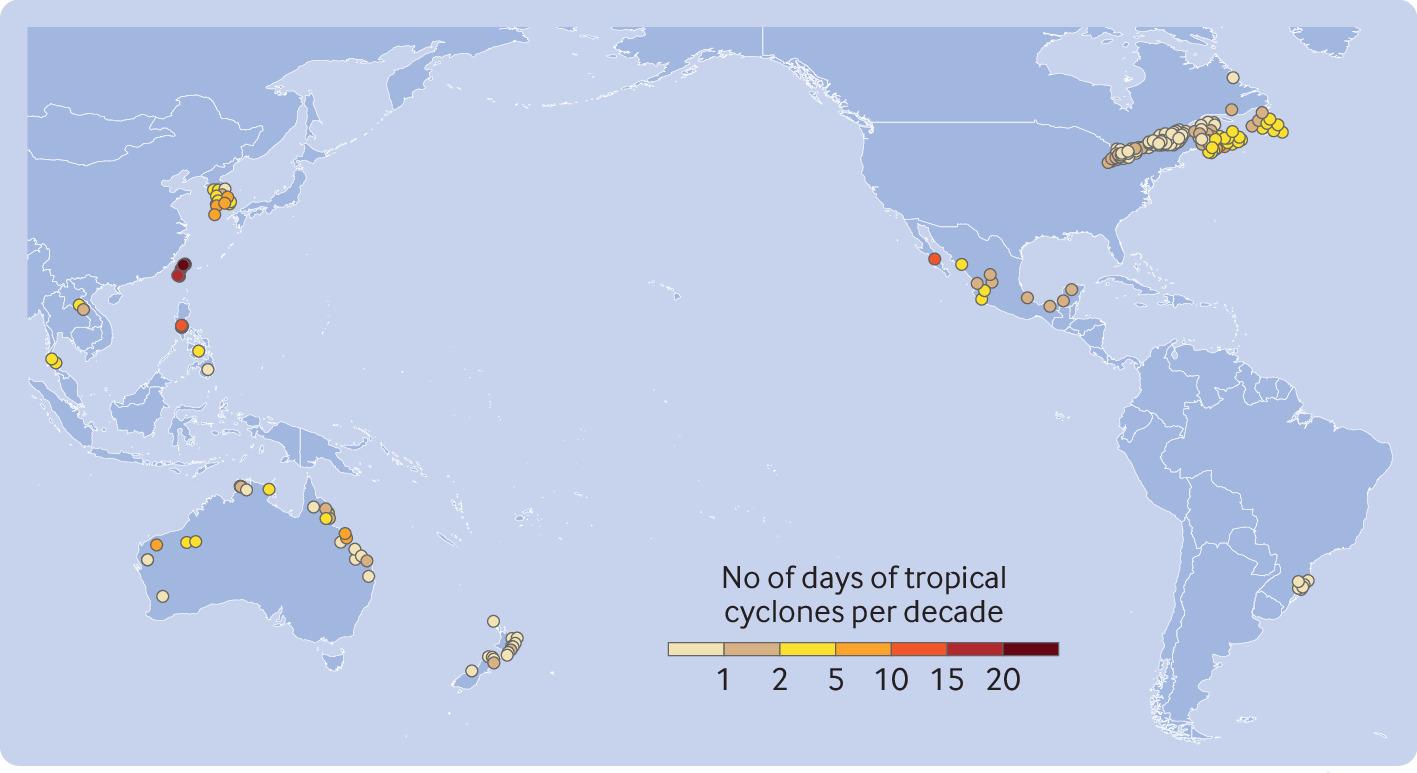
Setting Nine countries or territories (Australia, Brazil, Canada, South Korea, Mexico, New Zealand, the Philippines, Taiwan, and Thailand), covering tropical, subtropical, and extra-tropical regions.
Participants General populations living in regions with tropical cyclones in the nine countries or territories, 2000-19.
Main outcomes measures Excess mortality risk of cardiovascular diseases, respiratory diseases, infectious diseases, injuries, neuropsychiatric disorders, renal diseases, digestive diseases, diabetes, and neoplasms as the leading cause of death. Wind speed and rainfall profiles were quantified with a physics based tropical cyclone field model.
Results 14.8 million deaths and 217 tropical cyclone events in communities from the nine countries or territories were included in the analysis. Mortality risks from various causes consistently increased after tropical cyclones, with peaks occurring within the first two weeks after the cyclone, followed by a rapid decline. During the first two weeks after a tropical cyclone, the highest increases were seen in mortality from renal diseases and injuries, with a cumulative relative risk of 1.92 (95% confidence interval (CI) 1.63 to 2.26) and 1.21 (1.12 to 1.30), respectively, for each additional tropical cyclone day. Relatively more modest risks were found for mortality from diabetes (cumulative relative risk 1.15, 95% CI 1.08 to 1.21), neuropsychiatric disorders (1.12, 1.05 to 1.19), infectious diseases (1.11, 1.05 to 1.17), digestive diseases (1.06, 1.02 to 1.09), respiratory diseases (1.04, 1.00 to 1.08), cardiovascular diseases (1.02, 1.01 to 1.04), and neoplasms (1.02, 1.00 to 1.04). Mortality risks were substantially higher in communities with greater levels of deprivation and in those with historically fewer tropical cyclones, especially for renal, infectious, and digestive diseases, as well as for diabetes. Rainfall related to tropical cyclones had a more consistent increasing exposure-response relation with mortality risks, particularly for deaths related to respiratory, cardiovascular, and infectious diseases.



Conclusions After tropical cyclones, mortality risk increased variably for different causes, populations, and regions. Integrating epidemiological evidence into the development of management systems for climate extremes is urgently needed, particularly in regions with higher levels of deprivation and in those with historically fewer tropical cyclones. These measures are necessary to improve the adaptive capacity in responding to the growing risks and shifting activity of tropical cyclones in a warming climate.
