JOURNAL ARTICLE EDITOR'S CHOICE
Duration of Therapy for Pseudomonas aeruginosaBacteremia—A Post Hoc Subgroup Analysis From the BALANCE Randomized Controlled Trial
Dafna Yahav, Ruxandra Pinto, Deborah Cook, et al
Clinical Infectious Diseases, Volume 83, Issue 1, 15 July 2026, Pages 41–47, https://doi.org/10.1093/cid/ciag144
Abstract
Background
Despite the clinical significance of Pseudomonas aeruginosa bacteremia, the optimal duration of antibiotic therapy is unclear. We aimed to explore the association of antibiotic duration on mortality in hospitalized patients with P aeruginosa bacteremia.
Methods
This study was a post hoc analysis of all patients with P aeruginosa bacteremia included in the Bacteremia Antibiotic Length Actually Needed for Clinical Effectiveness (BALANCE) randomized controlled trial comparing 7 versus 14 days of antibiotic therapy for bacteremia. The primary outcome was 90-day mortality. Unadjusted risk differences (RDs) with 95% CIs for outcomes were calculated for patients randomized to 7 versus 14 days of treatment. Multivariable logistic regression was used to evaluate independent predictors of mortality.
Results
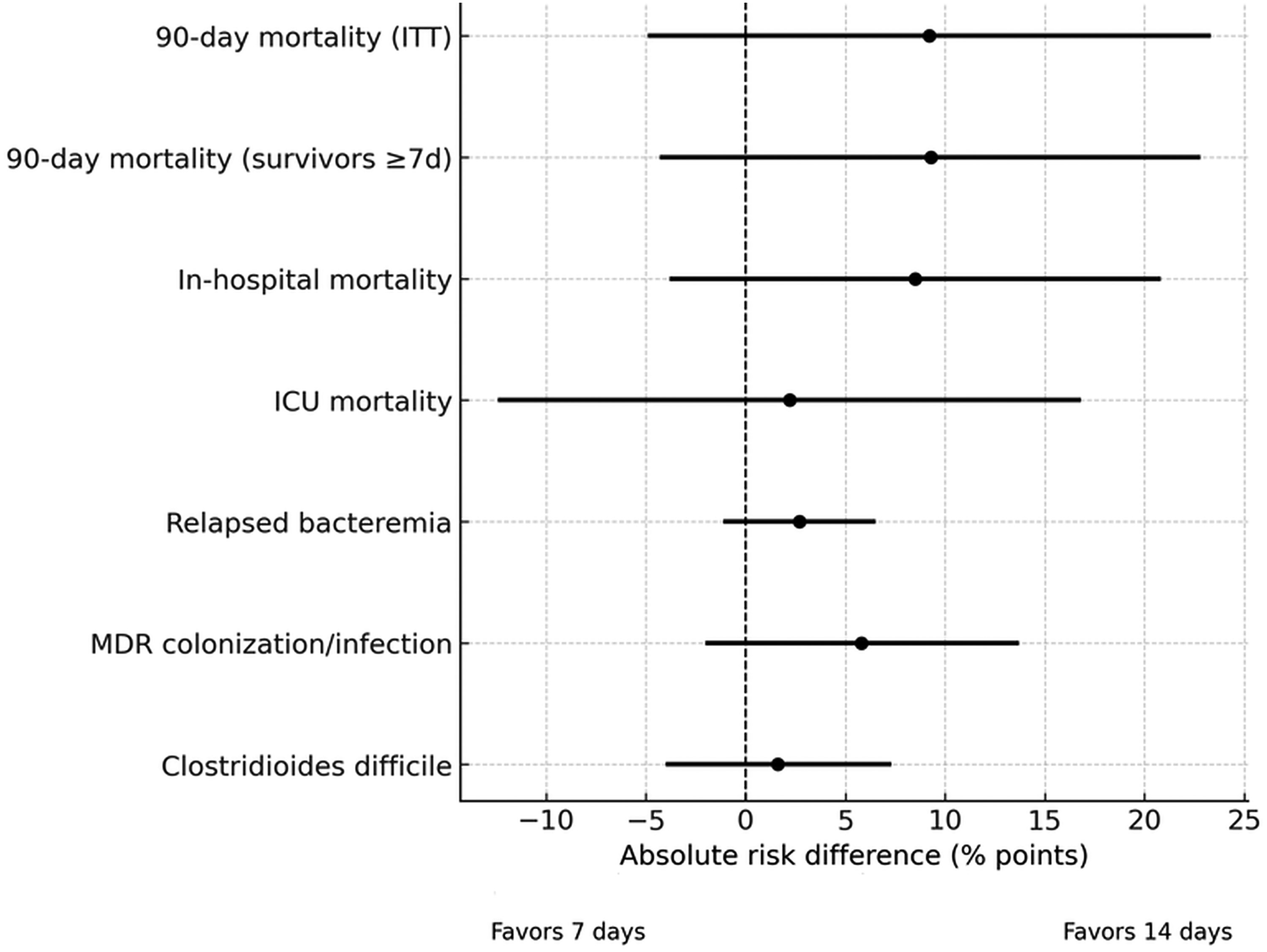
Among 157 patients with P aeruginosa bacteremia, 74 were randomized to 7 days of antibiotic treatment and 83 to 14 days. Patients in the 7-day group were more likely to be men and acquire infection in hospital. Crude mortality at 90 days in the intention-to-treat population was 22/74 (29.7%) in the 7-day group versus 17/83 (20.5%) in the 14-day group (RD: 9.2; 95% CI: −4.8 to 23.2). Age was associated with 90-day mortality (odds ratio [OR]: 1.06; 95% CI: 1.02–1.09), but randomization group (7 or 14 days) was not (OR: 1.47; 95% CI: .66–3.27).

Conclusions
Among patients with P aeruginosa bacteremia included in an international trial testing duration of antibiotic treatment, no significant difference in mortality was demonstrated between 7 versus 14 days of antibiotic therapy; however, a limited sample size precludes a conclusion of noninferiority, benefit, or harm.
