Research
Effect of lateral versus supine positioning on hypoxaemia in sedated adults: multicentre randomised controlled trial
Hui Ye, Li-Hua Chu, Guo-Hao Xie, et al
BMJ 2025; 390 doi: https://doi.org/10.1136/bmj-2025-084539 (Published 19 August 2025)Cite this as: BMJ 2025;390:e084539
Abstract
Objectives To evaluate the effect of lateral versus supine positioning on incidence of hypoxaemia in sedated patients and to provide evidence based recommendations for respiratory strategies.
Design Prospective, multicentre, randomised controlled trial.
Setting 14 tertiary hospitals in China, July to November 2024.
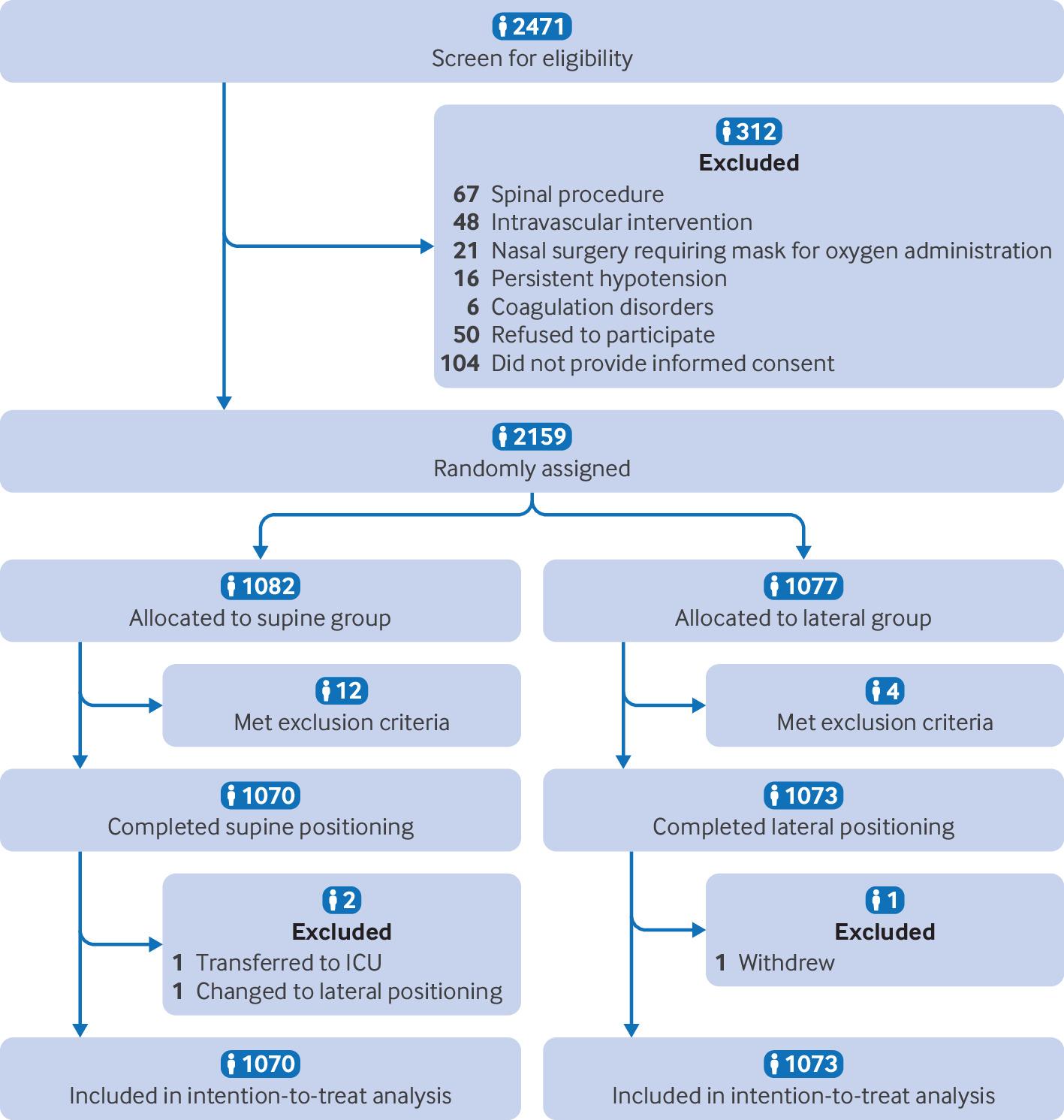
Participants 2159 adults (≥18 years) who underwent sedation.
Interventions Sedated patients were randomly assigned (1:1) to receive either lateral positioning or conventional supine positioning, stratified by study centres.
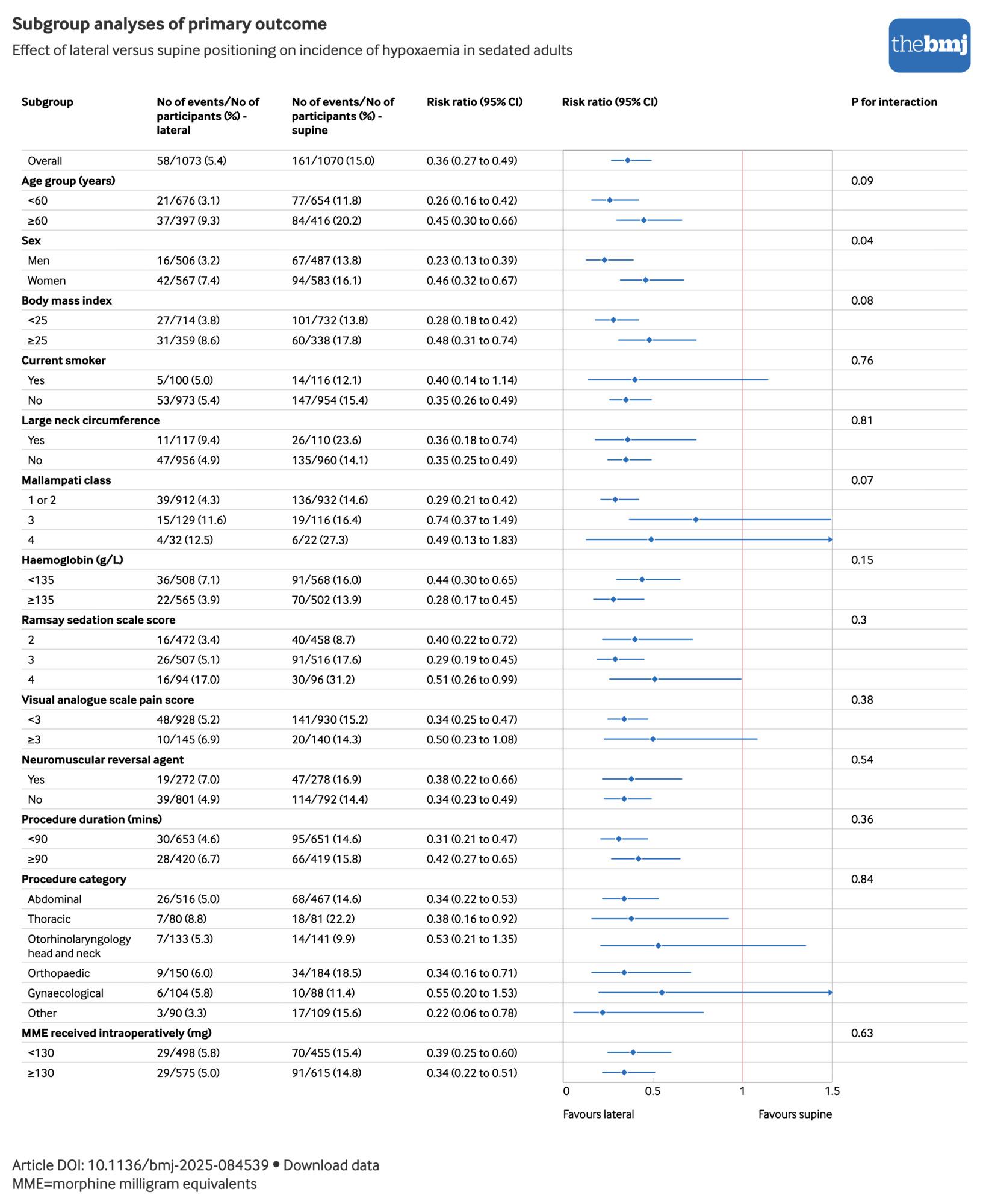
Main outcome measures The primary outcome was incidence of hypoxaemia (peripheral oxygen saturation (SpO2) ≤90%) within the first 10 minutes after positioning. Secondary outcomes included airway rescue interventions, incidence of severe hypoxaemia (SpO2 ≤85%), lowest oxygen saturation recorded, length of stay in the post-anaesthesia care unit, and safety measures (eg, bradycardia, tachycardia, hypotension, new onset arrhythmia). Analyses were performed on an intention-to-treat basis.
Results Of 2159 patients randomised, 2143 were included in the primary analysis. The mean age of the patients was 53.1 years, mean body mass index was 23.9, and 53.7% (1150/2143) were women. The incidence of hypoxaemia was significantly lower in the lateral group compared with supine group (5.4% (58/1073) v15.0% (161/1070); adjusted risk ratio 0.36, 95% confidence interval (CI) 0.27 to 0.49; P<0.001). Compared with patients in the supine group, patients in the lateral group required fewer airway rescue interventions (6.3% (68/1073) v 13.8% (148/1070); adjusted risk ratio 0.46, 0.34 to 0.61; P<0.001), had a lower incidence of severe hypoxaemia (0.7% (8/1073) v 4.8% (51/1070); adjusted risk ratio 0.16, 0.07 to 0.33; P<0.001), and had a higher mean lowest SpO2 level (96.9% v 95.7%, absolute adjusted mean difference 1.20%, 95% CI 0.87% to 1.54%; P<0.001). Additionally, length of stay in the post-anaesthesia care unit was shorter in the lateral group (38.2 v40.5 minutes; absolute adjusted mean difference −2.22 minutes; 95% CI −3.63 to −0.80; P=0.002). Safety outcomes were comparable between the groups, but tachycardia was less frequent in the lateral group.
Conclusions Placing sedated adults in the lateral position significantly reduces the incidence and severity of hypoxaemia and decreases the need for airway rescue interventions without compromising safety. Given its simplicity and low cost, lateral positioning could offer advantages in remote or resource constrained clinical settings. Further replication studies targeting patients with advanced age and high body mass index are needed to improve the generalisability of the findings.
Trial registration ClinicalTrials.gov NCT06459167.
